
Supplier Evaluation Checklist for Stainless Steel Double-Door Outdoor Electrical Enclosures
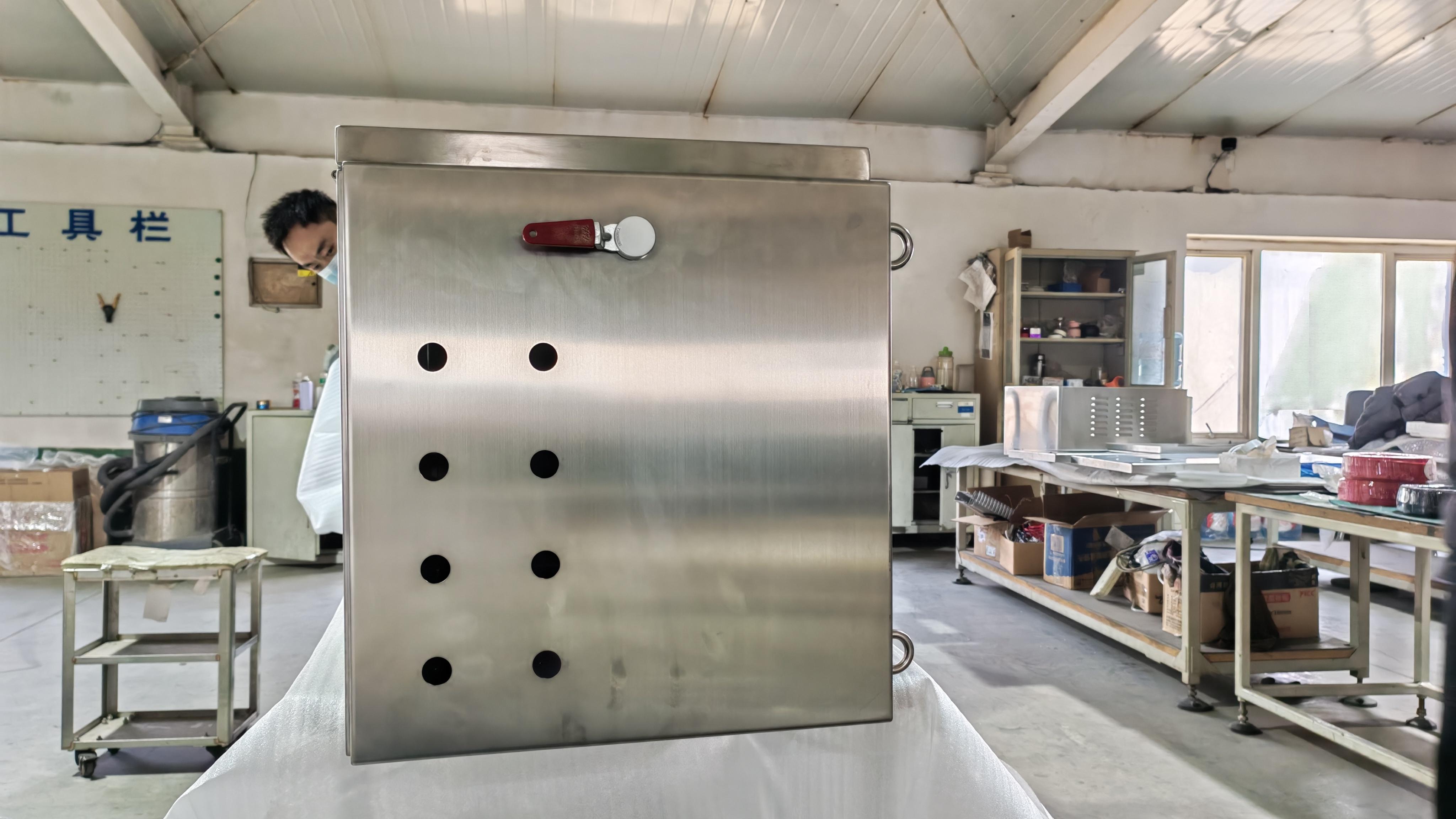
Stainless steel double-door outdoor enclosure: the door, the gasket, the internal rack and the cable entry — not the brochure photo — decide whether the cabinet survives its first winter on site.
A stainless steel double-door outdoor electrical enclosure is rarely a repeat purchase. It is specified once for a communication base station, an energy storage power station, a chemical plant or a coastal installation, and then it is expected to keep dust, rain, salt spray and UV out for years. Because the purchase is infrequent and configuration-specific, most evaluation happens through catalogues, quotations and photographs — which is precisely where supplier claims and site reality diverge.
This checklist is written for the verification stage of that purchase. It covers the specific category of stainless steel double-door outdoor cabinets used for communication equipment, energy storage batteries, PLC and frequency converter assemblies, and outdoor distribution components, and it focuses on the points a buyer can physically check before releasing a volume order.
Short answer: evaluate a supplier of stainless steel double-door outdoor electrical enclosures against six verifiable layers — (1) stainless grade and measured plate thickness (1.5 mm on the standard double-door outdoor cabinet, 2.0 mm on the 316-grade communication/energy-storage cabinet); (2) door hardware, meaning a stainless steel handle lock with keys and a continuous EPDM sealing strip in the door frame; (3) protection rating confirmed in writing (IP65) with third-party conformity evidence; (4) internal configuration, meaning 19-inch rack, shelves and mounting plates with an internal grounding bar; (5) cable entry, meaning pre-drilled knockout holes at the bottom or back with configurable stainless steel waterproof cable glands; and (6) delivery assurance, meaning a stable customizable model designation, fixed drawings, verified capacity and defined acceptance criteria.
Problem Definition: Why Supplier Claims and Site Reality Diverge
Most enclosure disputes do not begin with a broken cabinet. They begin with a detail that was never written into the specification, was never measurable on a sample, and only becomes visible after the cabinet has been installed in a coastal yard, a chemical park or a substation compound.
Material and thickness substitution. A 1.5 mm stainless steel double-door cabinet and a thinner nominally similar cabinet look almost identical in a product photo and feel similar in a quick hand check. Thickness affects door rigidity, hinge retention, resistance to panel deformation during transport and how well the door frame keeps its geometry over time. If the plate thickness is not stated as a controlled value on the drawing, the buyer has no measurement baseline.
Door hardware and sealing. The door is the only moving, load-bearing, weather-exposed interface on the enclosure. A stainless steel handle lock with keys, a door frame fitted with an EPDM (Ethylene Propylene Diene Monomer) sealing strip, and reliable grounding bonding between door and cabinet body are the three hardware items that determine whether rain, dust and static discharge are managed or merely assumed. A gasket that is interrupted at the corners, or a lock that is not stainless, fails first in exactly the environments the cabinet was bought for.
Internal configuration and cable entry. Two-door cabinets are bought as equipment housings, not as empty boxes. If the 19-inch rack, shelves or mounting plates do not align with the installed communication equipment, battery modules, PLC or frequency converters, the mismatch surfaces during commissioning. The same applies to cable entry: pre-drilled knockout holes at the bottom or back, and the ability to fit stainless steel waterproof cable glands in the required quantities and sizes, decide whether the installation is sealed or improvised on site.
Re-order and documentation drift. Project phases are usually split across months. If the supplier's model designation is not stable and the drawing set is not frozen, the second batch will not match the first — different cutouts, different internal rails, different finish.
Industry Background: Where Stainless Outdoor Enclosures Sit in 2026
Electrical enclosures are a large and still expanding category. The global electrical enclosure market was valued at USD 14.02 billion in 2024 and is projected to reach USD 23.65 billion by 2032, according to Market Research Future. Metallic enclosures — which include stainless steel and carbon steel — accounted for 65% of global electrical enclosure demand in 2025, valued at approximately USD 4.73 billion, based on Custom Market Insights data.
The regional centre of that demand is in Asia. Asia Pacific dominated the electrical enclosure market in 2025 with a 36% share, driven by industrial automation and renewable energy investment in China and India, according to IMARC Group. That matters for buyers in two ways: it concentrates manufacturing and customization capability in the region, and it increases the number of suppliers who can quote a stainless outdoor cabinet, which raises the value of a structured evaluation process.
On the technical side, the rating system buyers rely on is defined internationally. IEC 60529 (IP Code) is the dominant international standard for rating electrical enclosure protection against dust and water; under it, IP66 requires no ingress of dust and protection against powerful water jets. This is the reference point to keep in mind when a brief calls for a certain protection level and a supplier answers with a different one.
Customization is no longer a niche request. A 2024 electrical enclosure market report estimates that roughly 18% of enclosure buyers require highly customized solutions, which in practice translates into demand for OEM and ODM production services rather than catalogue selection. In this environment, the question is no longer whether a supplier can produce a stainless double-door cabinet, but whether the supplier can prove the specific configuration it quoted.
What the Checklist Must Actually Verify: Six Layers
A supplier evaluation for this product category should be structured around six verifiable layers. Each layer has a physical or documentary answer, and each can be closed out before a purchase order is placed.
- Material layer — stainless grade (304 or 316) and controlled plate thickness.
- Door hardware and sealing layer — stainless steel handle lock with keys, EPDM sealing strip in the door frame, door-to-body grounding bonding.
- Protection and conformity layer — IP rating stated for the exact model, supported by third-party conformity verification against the relevant standard.
- Internal configuration layer — 19-inch rack, shelves and mounting plates, internal grounding bar, clearance matched to the installed equipment.
- Cable entry layer — pre-drilled knockout holes at bottom or back, configurable stainless steel waterproof cable glands, optional reserved top penetration.
- Delivery and documentation layer — stable customizable model designation, frozen drawings, stated capacity, defined quality control gates and acceptance criteria.
The six layers are not equally weighted in every project. A cabinet destined for an inland communication base station and a cabinet destined for a coastal port differ mainly in material grade and corrosion exposure, while the door hardware, internal configuration and cable entry checks remain the same.
Step-by-Step Supplier Evaluation Checklist
Step 1 — Confirm the stainless grade against the actual environment
Establish whether the site is inland, chemical or coastal before discussing price. Stainless steel double-door outdoor cabinets are specified in a standard stainless version and in a 316 version, and the 316 material is the one associated with resistance to strong acids, strong alkalis, salt spray and seawater corrosion, which is why it is used in coastal and chemical scenarios. A supplier that offers only one grade for all environments is a supplier that has not been asked the question yet.
Step 2 — Measure plate thickness at three locations, not one
Plate thickness is the single most common undocumented variable. On the standard stainless steel double-door outdoor cabinet, the specified plate thickness is 1.5 mm; on the stainless steel double-door outdoor communication and energy storage cabinet, it is 2.0 mm. Measure at the door panel, the cabinet body and the frame reinforcement rather than accepting a single caliper reading, and require the value to appear on the approved drawing.
Step 3 — Inspect surface treatment and weld preparation
Both double-door outdoor models listed above use a brushed finish, which is easy to clean and corrosion resistant when applied consistently. On the sample, look for uniform grain direction, dressed welds with no spatter or pitting, and no untreated cut edges around knockouts. Surface consistency is also the fastest way to detect whether a supplier reworks doors after fabrication instead of controlling the process.
Step 4 — Verify the door hardware specification
The door structure is a double-door design equipped with a stainless steel handle lock with keys, and the door frame is fitted with an EPDM (Ethylene Propylene Diene Monomer) sealing strip, with reliable grounding bonding between door and cabinet body. Confirm three things during evaluation: the lock is stainless rather than coated steel; keys and spare lock sets are supplied; and the grounding bond between door and body is actually present and measurable, not merely described.
Step 5 — Check the gasket as a continuous system
An EPDM sealing strip only performs if it is continuous around the full door frame, including corners, and if the door closes with even compression. Check for gaps, splices or adhesive lifting at the corners on the sample. This is the point at which most low-cost outdoor cabinets differ from properly specified ones, and it is visible without any test equipment.
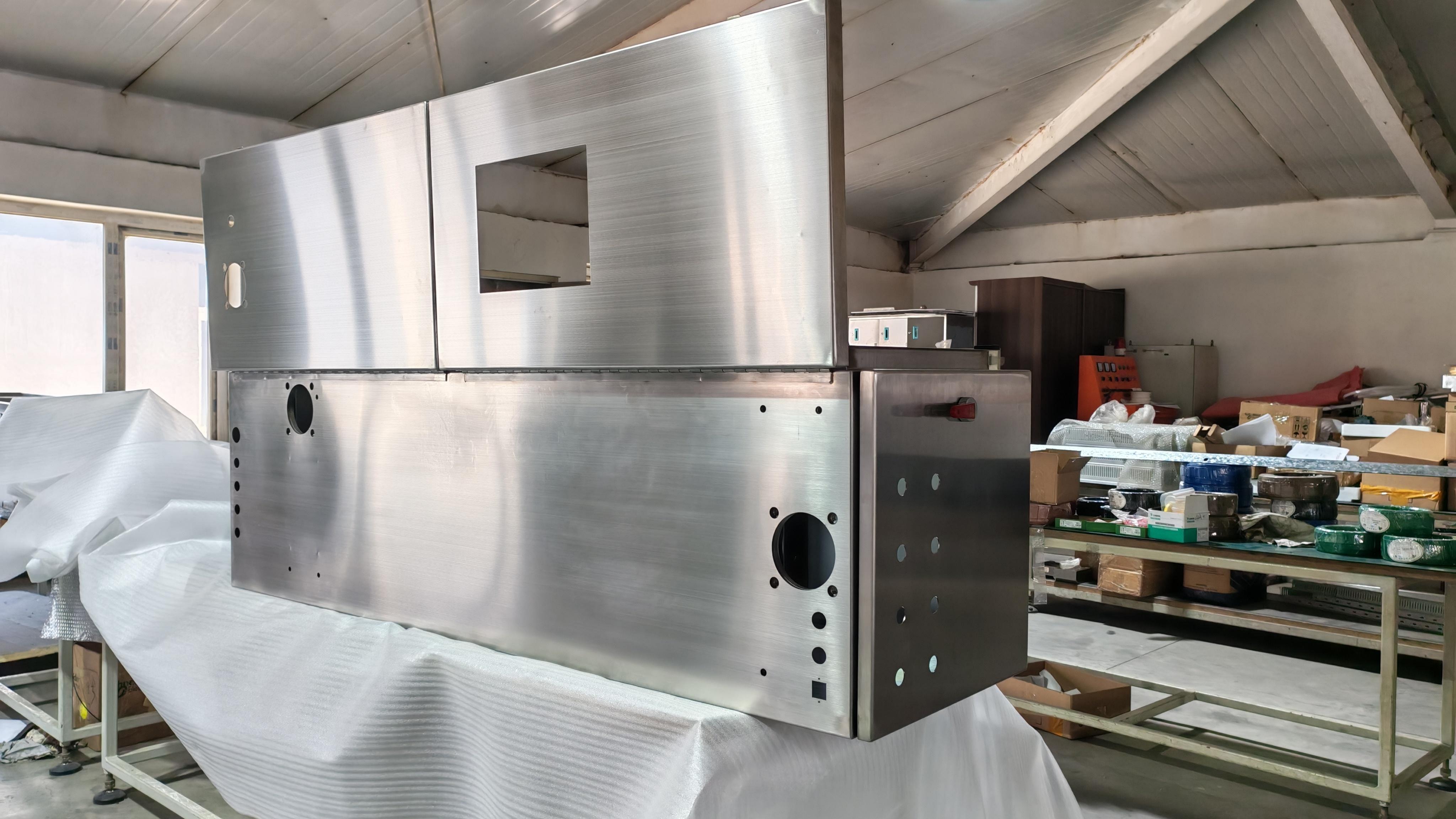
Door hardware evaluation: stainless steel handle lock, door frame EPDM sealing strip and door-to-body grounding bonding are the three checkable items at this stage.
Step 6 — Confirm the protection rating in writing, with conformity evidence
The stainless steel double-door outdoor cabinet and the stainless steel double-door communication/energy storage cabinet are both specified at IP65 — dust-tight and protected against water jets. Ask for the rating in writing for the exact model being quoted, not for the product family. Where the project requires documented conformity, request third-party verification: Dalian Yinlu holds an SGS-CSTC Standards Technical Services Verification of Conformity (certificate IN-DL-5805-22013-1) covering the DLYL-ES-C electric control cabinet against EN 60529:1991+A1+A2 and the EU Low Voltage Directive 2014/35/EU, plus a second verification (certificate IN-DL-5805-22013-2) for the DLYL-AE-B electric control box. Because IEC 60529 is the underlying standard for IP ratings, a certificate referencing EN 60529 is directly relevant to how the IP claim was tested.

Third-party conformity documentation: SGS-CSTC Verification of Conformity referencing EN 60529:1991+A1+A2 for Yinlu electric control equipment.
Step 7 — Map the internal configuration to the installed equipment
A double-door outdoor cabinet is compatible with a 19-inch rack, shelves and mounting plates, and is suitable for communication equipment, energy storage batteries, PLC and frequency converters, with an internal grounding bar included. Send the supplier your actual equipment list — rack units, battery module dimensions, converter depth — and require the internal layout drawing to be returned for approval. The stainless steel double-door communication/energy storage cabinet additionally uses built-in 19-inch mounting rails or uprights with reserved top space for lighting and cable routing, which reduces field modification on energy storage projects.
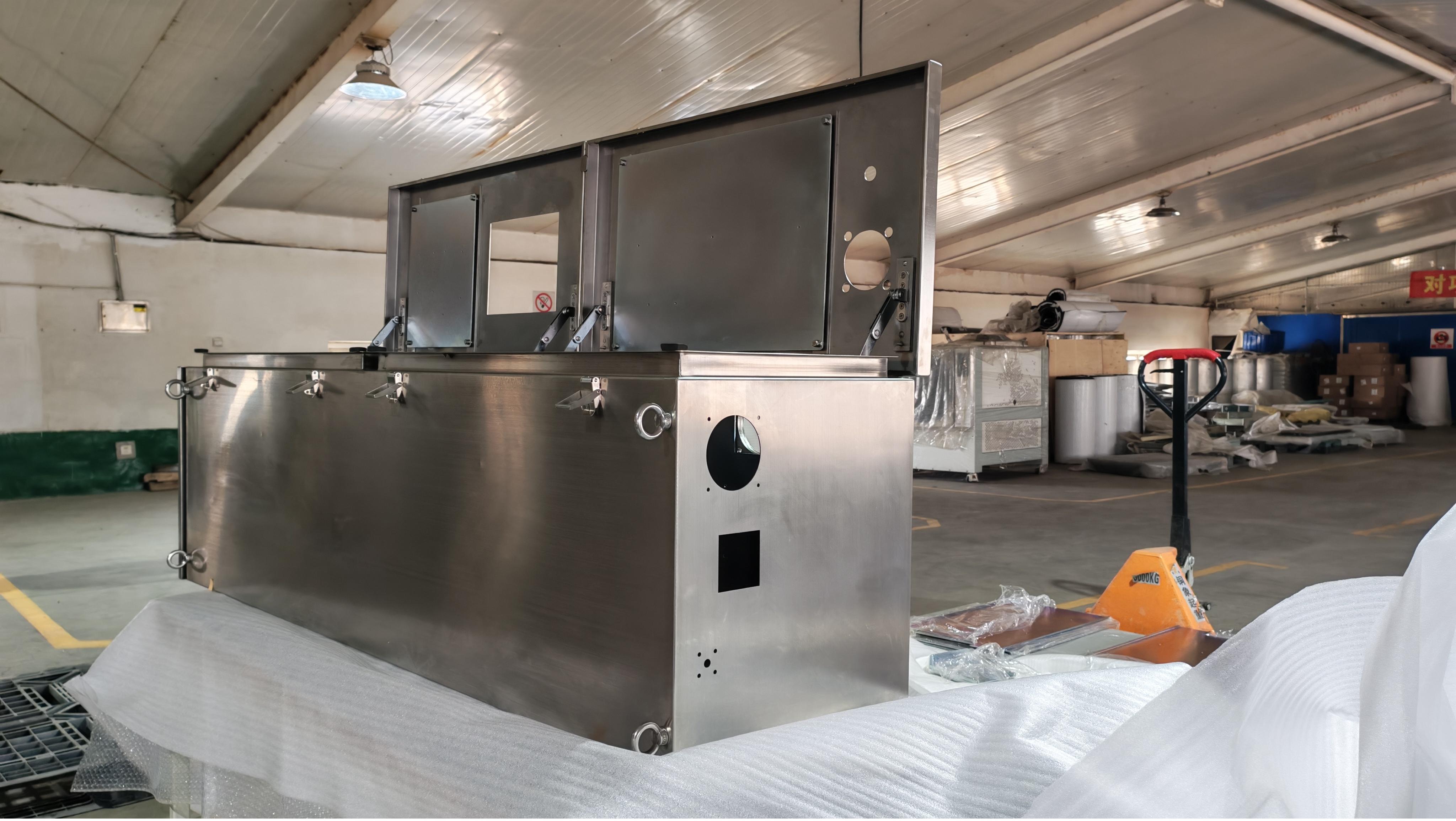
Internal configuration check: 19-inch rack, shelves, mounting plates and an internal grounding bar must match the equipment list before the order is released.
Step 8 — Verify cable entry as a designed interface
Cable entry is specified as pre-drilled knockout holes at the bottom or back, configurable with stainless steel waterproof cable glands. On the communication/energy storage model there is also a reserved cable or pipe penetration interface at the top. During evaluation, confirm the number, diameter and position of knockouts against your cable schedule, confirm that the glands are stainless rather than plated, and confirm that glands are included in scope rather than treated as an accessory to be sourced locally.
Step 9 — Check the environmental envelope claims
The standard double-door outdoor cabinet is rated for an ambient temperature range of -20 °C to +60 °C, extendable to -40 °C to +80 °C in the 316 grade version, with relative humidity up to 95% non-condensing and optional heater or dehumidifier for condensing environments. The finish is described as UV-resistant, anti-aging and acid-rain-proof for long-term outdoor exposure to sunlight, rain and snow. For cold-region or high-altitude projects, ask how condensation and internal temperature are managed; for humid coastal projects, ask about the heater or dehumidifier option.
Step 10 — Lock the model designation, capacity and acceptance terms
Delivery assurance is a documentation problem before it is a logistics problem. Confirm the following before releasing an order: a customizable model designation that stays constant across batches; a frozen drawing and cutout set; stated production capacity (Dalian Yinlu lists a monthly capacity of 2,000 units); the minimum order quantity (1–5 units, which allows a single verification unit); the acceptance criterion (a power-on test); and the after-sales terms (7×24 hours online support with a 1-year warranty). Payment terms available include TT, PayPal, LC and Visa, and delivery terms include FOB, CIF, EXW, DAP, CFR and DDP.
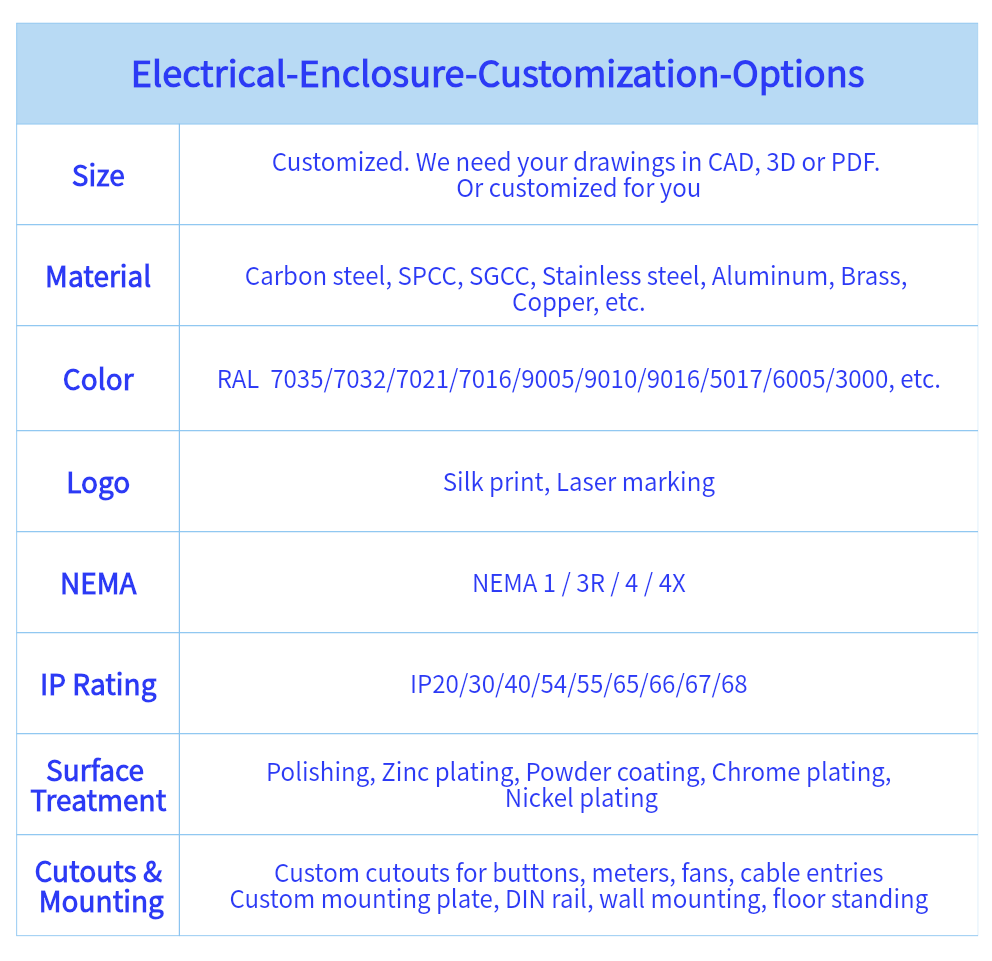
Customization control: material, color, logo, size, IP rating, surface treatment, cutouts and mounting should all be fixed on one approved specification sheet.
Evaluation Evidence Table: What to Ask, What Counts as Proof
| Checklist item | What to verify | Evidence that closes the item | Weak signal |
|---|---|---|---|
| Stainless grade | 304 or 316 selected against inland, chemical or coastal exposure | Material declaration on the approved drawing | One grade offered for every environment |
| Plate thickness | 1.5 mm standard double-door outdoor cabinet; 2.0 mm communication/energy storage cabinet | Drawing value plus caliper measurement at door, body and frame | Thickness described only as heavy-duty or reinforced |
| Door hardware | Stainless steel handle lock with keys; door-to-body grounding bonding | Physical check on the sample; hardware listed in the bill of materials | Lock type not named; grounding bond not demonstrated |
| Sealing | EPDM sealing strip continuous in the door frame | Visual and compression check around the full frame | Gasket stops short at corners or shows adhesive lifting |
| Protection rating | IP65 stated for the exact quoted model | Written rating plus third-party conformity certificate referencing EN 60529 | Rating quoted for the product family only |
| Internal configuration | 19-inch rack, shelves, mounting plates, internal grounding bar | Approved internal layout drawing matched to the equipment list | Layout confirmed only verbally |
| Cable entry | Pre-drilled knockouts at bottom/back; configurable stainless steel waterproof glands | Knockout drawing checked against the cable schedule; glands in scope | Glands treated as a local purchase item |
| Delivery assurance | Stable model designation, capacity, MOQ, acceptance criteria | Quotation stating MOQ, terms, acceptance test and capacity | No fixed designation for reorders |
Use Cases: Where Double-Door Stainless Outdoor Cabinets Are Deployed
The stainless steel double-door outdoor cabinet is designed for highly corrosive and harsh outdoor environments and is used in communication base stations, energy storage power stations, chemical industry sites and coastal projects. The stainless steel double-door communication and energy storage variant extends that scope to communication base stations (5G/4G), energy storage power stations, outdoor photovoltaic systems, chemical industry parks, coastal ports, offshore platforms and sewage treatment plants.
The practical difference between these scenarios is not the cabinet shape but the exposure profile. Coastal ports and offshore platforms drive the choice toward the 316 version because of salt spray and seawater corrosion. Chemical industry parks add acid and alkali exposure. Energy storage and photovoltaic installations add internal heat generation, which is why the internal rack space and the options for ventilation, louvered panels or cooling accessories need to be resolved at the drawing stage rather than after commissioning.
A representative example is the PACRAFT project in Japan, where 1,000 units of stainless steel non-standard custom enclosures were produced using 304/316 stainless steel with protection levels from IP55 to IP67, targeting a service life of 10–15 years under normal operating conditions. The relevant lesson for buyers is structural: non-standard geometry was combined with a standardized material and protection specification, which is what made a 1,000-unit batch repeatable.
Model-Level Comparison: Two Stainless Double-Door Configurations
| Verification point | Stainless Steel Double-Door Outdoor Cabinet | Stainless Steel Double-Door Outdoor Communication / Energy Storage Cabinet |
|---|---|---|
| Plate thickness | 1.5 mm | 2.0 mm |
| Material | Stainless steel | 316 stainless steel |
| Surface treatment | Brushed finish | Brushed finish |
| Protection grade | IP65 | IP65 |
| Installation | Floor-mounted | Floor-mounted |
| Door structure | Double door, stainless steel handle lock with keys, EPDM sealing strip, door-to-body grounding bonding | Double door, stainless steel handle lock with keys, EPDM sealing strip, door-to-body grounding bonding; some models with bottom ventilation louver |
| Internal configuration | Compatible with 19-inch rack, shelves and mounting plates; internal grounding bar included | Built-in 19-inch mounting rails/uprights; internal grounding bar; reserved top space for lighting and cable routing |
| Cable entry | Pre-drilled knockouts at bottom/back; configurable stainless steel waterproof cable glands | Pre-drilled knockouts at bottom/back with configurable stainless steel glands; reserved cable/pipe penetration interface at top |
| Typical applications | Communication base stations, energy storage power stations, chemical industry, coastal projects | Communication base stations (5G/4G), energy storage power stations, outdoor PV, chemical industry parks, coastal ports, offshore platforms, sewage treatment plants |
Reading the table correctly: the 1.5 mm model is not an inferior version of the 2.0 mm model — they serve different exposure profiles. The evaluation question is whether the supplier can tell you which one fits your site, and whether the quoted configuration matches the drawing you approve.
Frequently Asked Questions
What protection rating and certification evidence should I request from a stainless steel double-door outdoor enclosure supplier?
Request the IP rating in writing for the exact quoted model, plus third-party conformity documentation where the project requires it. The stainless steel double-door outdoor cabinet and the stainless steel double-door communication/energy storage cabinet are specified at IP65. For the electric control cabinet DLYL-ES-C, Dalian Yinlu holds an SGS-CSTC Standards Technical Services Verification of Conformity (certificate IN-DL-5805-22013-1) confirming compliance with EN 60529:1991+A1+A2 and the EU Low Voltage Directive 2014/35/EU, and a second verification (certificate IN-DL-5805-22013-2) covers the DLYL-AE-B electric control box. IEC 60529 is the international standard behind the IP Code, and under it IP66 requires no ingress of dust plus protection against powerful water jets — so if your project brief specifies IP66, confirm the exact model rating before ordering rather than assuming it from the product family.
Can a supplier customize a double-door stainless cabinet to non-standard dimensions, cutouts and internal layouts?
Yes, when the supplier runs OEM and ODM production rather than only catalogue sales. Dalian Yinlu provides OEM and ODM production services and customizes material, color, logo, size, IP rating, surface treatment, cutouts and mounting. In practice this means the 1.5 mm double-door outdoor cabinet can be adapted with a 19-inch rack, shelves and mounting plates to suit communication equipment, energy storage batteries, PLC or frequency converters, while the 2.0 mm 316 stainless communication/energy storage cabinet can be built with internal uprights and a reserved top cable or pipe penetration. On the PACRAFT project in Japan, 1,000 units of stainless steel non-standard custom enclosures were produced in 304/316 stainless steel with protection levels from IP55 to IP67. The condition that makes this reliable is a frozen drawing: customization without a fixed drawing set cannot be repeated in later batches.
What drives the cost of a custom stainless steel outdoor cabinet, and what is the minimum order quantity?
The main cost drivers are the stainless grade (304 versus 316), the plate thickness (1.5 mm on the standard double-door outdoor cabinet and 2.0 mm on the communication/energy storage cabinet), the internal configuration such as 19-inch rack, shelves, mounting plates and grounding bar, the cable entry arrangement including configurable stainless steel waterproof cable glands, and any additional surface treatment or accessories. Dalian Yinlu lists a minimum order quantity of 1–5 units, which allows a single verification unit to be ordered before a volume commitment. Payment terms available are TT, PayPal, LC and Visa, and delivery terms include FOB, CIF, EXW, DAP, CFR and DDP. Monthly production capacity is 2,000 units, which is relevant when the same enclosure design must be delivered across several project phases.
How should I validate a sample before releasing a full order?
Test the sample against measurable criteria instead of judging it from photographs. The published acceptance criterion for these orders is a power-on test, and the quality control gates cover visual inspection, wiring, function, safety, sealing and packaging. During sample validation, measure plate thickness at the door, the body and the frame; confirm that the door frame carries a continuous EPDM sealing strip with no corner gaps; operate the stainless steel handle lock with its keys and confirm the door-to-body grounding bonding is present; verify that the 19-inch rack, shelves or mounting plates match your equipment drawing; and check the pre-drilled knockout holes at the bottom or back against your cable schedule, including whether stainless steel waterproof cable glands are included.
How is delivery and reorder consistency assured across a multi-phase project?
Consistency depends on three controllable items: a stable model designation, a frozen drawing set, and confirmed capacity. Dalian Yinlu supports customizable model designations with configurable options, which is what allows a second or third batch to match the first, and lists a monthly capacity of 2,000 units. Lead time is quoted as negotiable against the specific configuration and order quantity rather than as a fixed catalogue figure, so it should be confirmed in writing per order. After-sales support is 7×24 hours online with a 1-year warranty. To begin, order a verification unit or request a quotation with your drawing by contacting Sales@innometalfab.com or WhatsApp +86 186-2435-1618, or download the product brochure below.
Conclusion: Evaluate the Configuration, Not the Catalogue
A supplier evaluation for stainless steel double-door outdoor electrical enclosures succeeds or fails on six checkable items: stainless grade, measured plate thickness, door hardware with EPDM sealing, protection rating with conformity evidence, internal configuration matched to installed equipment, and cable entry designed against the cable schedule. Everything else in a quotation is context.
The reason this checklist is worth running before an order is that these cabinets are installed in places where maintenance access is difficult and failure is expensive: communication base stations, energy storage power stations, chemical industry parks, coastal ports, offshore platforms and sewage treatment plants. Dalian Yinlu Electrical Control Equipment Manufacturer is a Dalian-based sheet metal fabrication and enclosure manufacturer producing metal enclosures and electrical control cabinets, with OEM and ODM production services and exports to North America, Europe, Australia and Japan. A verification unit ordered at the published minimum order quantity is the lowest-cost way to confirm that the configuration on paper is the configuration on site.
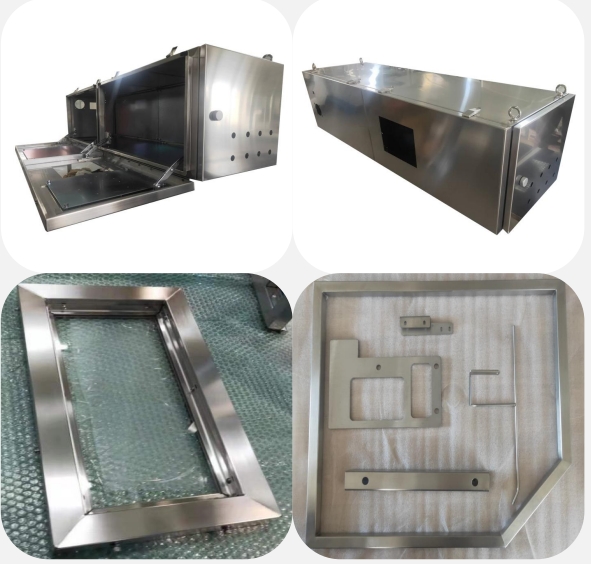
Verification unit first: confirm plate thickness, door hardware, sealing, internal layout and cable entry before committing to a volume order.
Next Step: Request a Sample or Quotation
Send your equipment list, cable schedule and site environment, and Dalian Yinlu will confirm the stainless grade, plate thickness, internal configuration and cable entry arrangement for your project. A single verification unit can be ordered at the published minimum order quantity of 1–5 units.
Email: Sales@innometalfab.com | WhatsApp / Tel: +86 186-2435-1618 | Website: www.innometalfab.com
Download the full product brochure: Yinlu Electrical Enclosure Brochure (PDF)
Have Questions or Need More Details?
Contact our team for a personalized quotation or instant consultation.
Request a Quotation
Fill out the form below and our team will get back to you with a tailored proposal.
WhatsApp Direct Chat
Prefer to chat in real-time? Message us on WhatsApp for instant assistance & quick answers.
- Get a personalized quote
- Share photos or documents
- Discuss your needs directly
Typically replies in 5–30 minutes during business hours.