
Corroding Coastal Enclosures: Stainless Double-Door Solution
Outdoor enclosures on coastal or chemical sites rarely fail in a single event. They fail at a detail: a scratch through the coating on a door edge, a rust bloom around a fastener, water tracking in through an oversized knockout, or an EPDM strip that has hardened after two summers of UV. By the time corrosion is visible on the outside of the cabinet, the steel behind the coating has usually been degrading for months.
This article treats that failure pattern as a specification problem rather than a maintenance problem. It sets out why outdoor cabinets degrade in salt-laden and acid-bearing environments, what Yinlu's stainless steel double-door outdoor cabinet actually specifies, how its door, sealing, cable-entry and internal-mounting details respond to each corrosion path, and which points a buyer should confirm before placing an order. The cabinet referenced throughout is Yinlu's stainless steel double-door outdoor cabinet, supplied as a non-standard custom build.
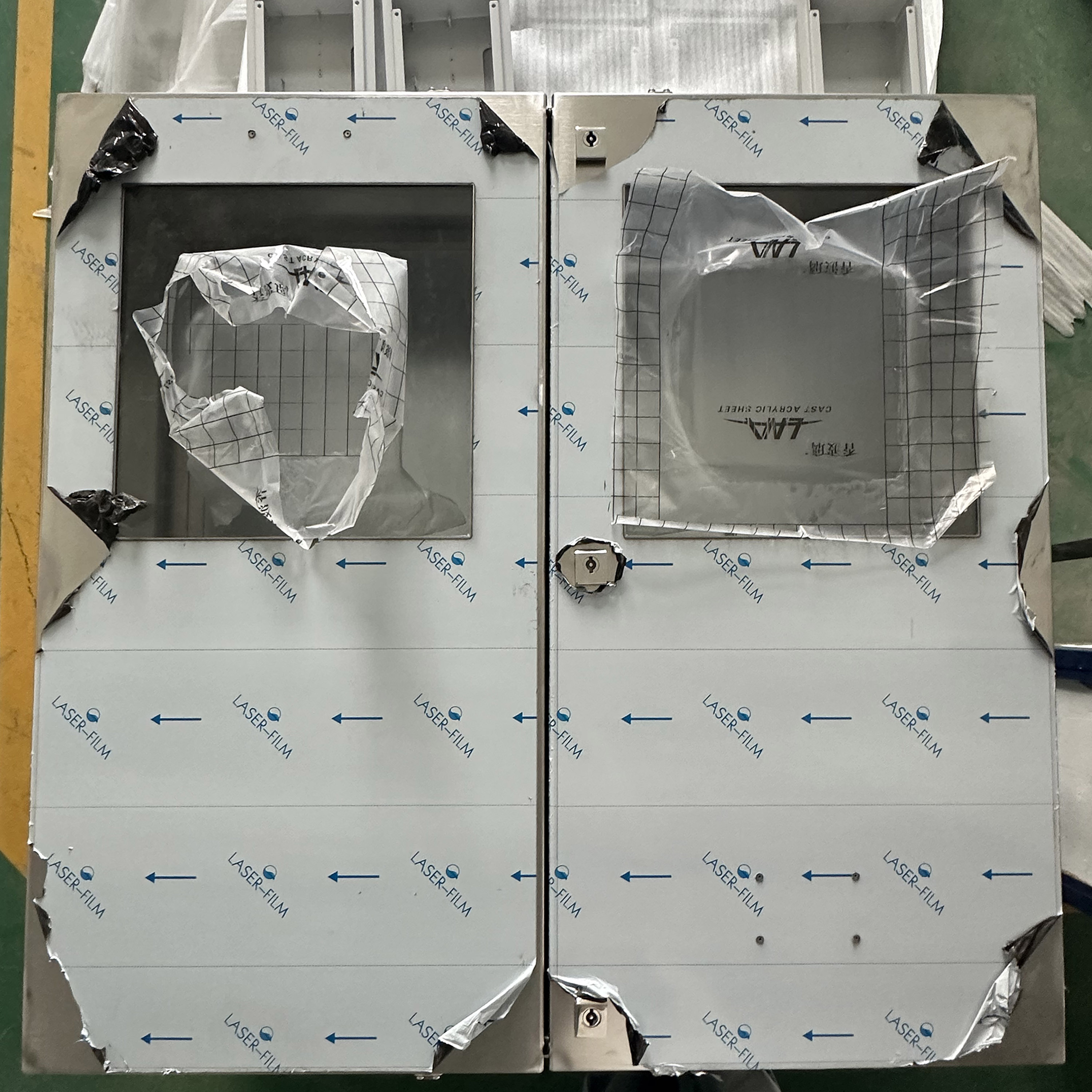
Stainless steel double-door outdoor cabinet: floor-mounted, brushed stainless steel body, double-door front with stainless steel handle locks.
Why outdoor enclosures corrode in coastal and chemical projects
Corrosion outdoors is driven by three factors acting together: chloride or acid-bearing air, water that arrives and then stays, and a material or coating system that tolerates neither. A coastal port, an offshore platform or a chemical park supplies all three at once, which is why the same cabinet that performs acceptably in an inland workshop can look neglected after a single season on the coast.
Coating breach and under-film corrosion on painted steel
A powder-coated carbon steel enclosure protects its substrate only while the film remains continuous. A cut edge, a weld seam, a fixing hole or a handling scratch exposes bare metal. Once moisture and chloride reach that point, corrosion can spread laterally beneath the coating and lift it away from the steel, so the visible blister is usually larger than the damage that started it. The supplied scenario guidance for Yinlu's range reflects this distinction: cold-rolled steel with electrostatic powder coating is described as suited to general industrial environments, while 304 or 316 stainless steel is preferred where salt spray and acid-base exposure are present.
Chloride attack and crevice corrosion on stainless steel
Stainless steel raises the corrosion threshold; it does not remove the mechanism. Chlorides can still cause staining and crevice attack where salt, dust and moisture are trapped — typically under the door seal lip, around hinges and fasteners, and in folded frame edges. That is why grade selection, a smooth brushed finish and a seal that sheds water matter as much as the word stainless on a datasheet.
Water entry at the cable knockout
The cable entry is usually the weakest point of any outdoor cabinet, because it is the one place where the installer deliberately breaks the enclosure skin. An oversized knockout, a gland that does not match the cable diameter, or a downward loop that drains into the cabinet instead of away from it will defeat an otherwise well-sealed body. Entry hardware is therefore part of the corrosion specification, not an accessory added at commissioning.
Condensation, thermal cycling, UV and acid rain
Even a closed cabinet exchanges heat with its surroundings. Day-night cycling draws moisture-laden air inward, and condensation forms on cool metal surfaces inside the cabinet, where it cannot dry quickly. UV exposure degrades elastomer seals, and acid rain attacks both the finish and any exposed fixing points. The content unit for this cabinet states UV resistance, anti-aging performance and acid-rain resistance for long-term outdoor exposure to sunlight, rain and snow — properties that need to be bought as part of the build, not assumed.
Material choice decides the rest of the specification
Material selection comes before dimensions, locks and accessories, because it determines how long every other detail will last. Yinlu's stainless steel scenario guidance distinguishes two grades: 304 stainless steel for general scenarios and 316 stainless steel for coastal and chemical scenarios, with salt spray and acid-base resistance and a brushed or polished surface finish. Grade 316 is a higher-alloy stainless steel that contains molybdenum, which is the usual reason it is specified where chlorides are persistent.
The double-door outdoor cabinet covered here is built in stainless steel with a 2.0 mm plate and a brushed finish, and it is floor-mounted. The grade is not something a buyer should leave to inference: if the site is a coastal port, an offshore platform or a chemical park, write 316 (or the grade your project specification requires) explicitly on the enquiry and on the purchase order, and ask for the material documentation that matches it.
Material direction in the wider category supports the same emphasis. A 2026 market analysis by Fortune Business Insights expects metallic enclosures, including stainless steel and aluminum, to account for a 52.81% share of the electrical enclosure market in 2026 — a reminder that in corrosive duty the enclosure material, not the paint system, is the primary corrosion barrier.
What the stainless steel double-door outdoor cabinet specifies
Yinlu's stainless steel double-door outdoor cabinet is a floor-standing outdoor unit built around a stainless steel body and a double-door front. Its stated configuration in the content unit is as follows.
- Body and finish: stainless steel construction with a 2.0 mm plate and a brushed finish.
- Protection rating: IP65 for this unit, as stated in the content unit.
- Door system: double-door design with a stainless steel handle lock supplied with keys; the door frame carries an EPDM (ethylene propylene diene monomer) sealing strip; the door is reliably bonded to the cabinet body for grounding.
- Internal configuration: built-in 19-inch mounting rails and uprights, compatible with communication equipment, energy storage batteries, PLCs and frequency converters; an internal grounding bar; reserved space at the top for lighting and cable routing.
- Cable entry and exit: pre-drilled knockout holes at the bottom and back, configurable with stainless steel waterproof cable glands; a cable and pipe penetration interface is reserved at the top.
- Ventilation: some models include a bottom ventilation louver.
- Installation: floor-mounted.
- Weather performance: UV-resistant, anti-aging and acid-rain-proof, intended for long-term outdoor exposure to sunlight, rain and snow.
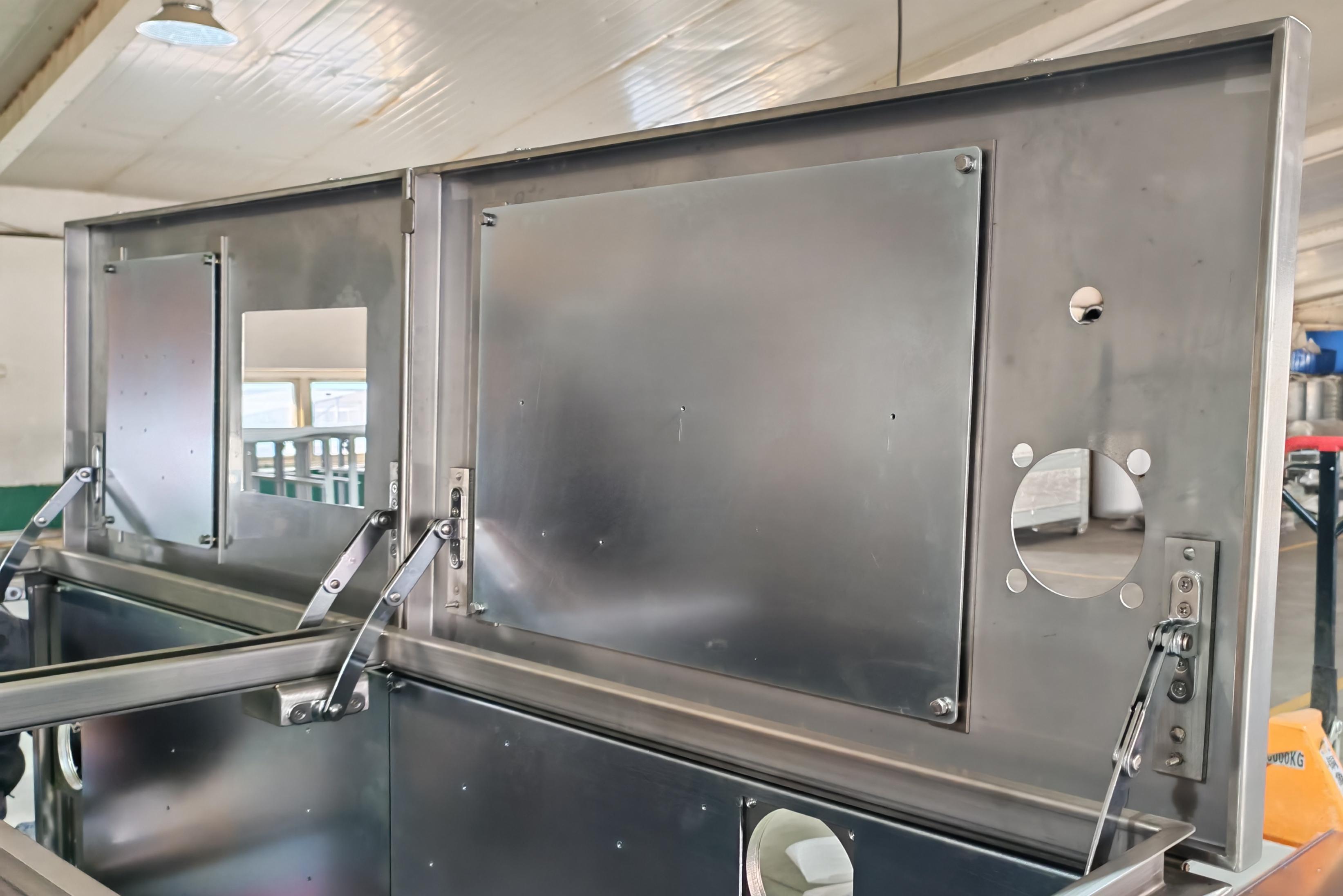
Stainless steel custom enclosure: non-standard builds are configured around the equipment, cable schedule and site exposure.
How the design responds to each corrosion path
The value of this cabinet in a corrosive project is not the word stainless alone; it is the way the body, doors, seal, cable entry and internal frame work as one assembly. Each element answers a specific failure mode described above.
Double doors, stainless handle locks and the EPDM sealing strip
A double-door front opens the full internal width, which matters when the cabinet carries 19-inch rack-mounted communication equipment, energy storage batteries or a PLC and frequency-converter assembly that has to be installed, wired and serviced in place. Wide access reduces the handling damage that occurs when equipment is forced through a single narrow opening, and handling damage is a common starting point for coating or surface damage on site.
The sealing detail is the more important one for corrosion. The door frame is fitted with an EPDM sealing strip, an elastomer chosen for outdoor exposure, and each door carries a stainless steel handle lock with keys. Stainless hardware avoids the small but persistent problem of plated locks and hinges rusting at the very point an operator touches the cabinet every week. Because the door is reliably bonded to the body, the seal does not come at the cost of electrical continuity.
Cable entry: precut knockouts plus stainless steel waterproof glands
The bottom and back of the cabinet carry pre-drilled knockout holes, and the build can be configured with stainless steel waterproof cable glands to match the cable schedule. Planning entry in one place — bottom or back, with glands sized to the actual cable diameters — keeps the enclosure skin intact and avoids field-cut openings that cannot be resealed. A cable and pipe penetration interface is reserved at the top for routing that must arrive from above; that interface must be closed and sealed according to the site's water path, and it should be confirmed on the drawing rather than assumed.
Internal frame: 19-inch rails, mounting plates and the grounding bar
Inside, the cabinet provides 19-inch mounting rails and uprights and accepts shelves and mounting plates, so the same body can host communication equipment, batteries, PLCs and drives without a separate sub-frame. The internal grounding bar and reserved top space for lighting and cable routing support a tidy, inspectable installation. A cabinet that is easy to inspect is a cabinet whose corrosion is caught early — the practical benefit of the internal layout is maintenance visibility, not just capacity.
Floor mounting and the ventilation trade-off
The cabinet is floor-mounted, which suits a low-voltage panel enclosure, a communication base station cabinet or an energy storage cabinet that is too large or too heavy for wall mounting. Ventilation needs care in a corrosive environment: the content unit lists a bottom ventilation louver on some models, and a louver is by definition an air path. Where a project requires the full sealing of the stated IP65 configuration, confirm the ventilation arrangement — louver, filter or none — in the quotation and drawing, and check that the chosen arrangement still matches the ingress protection the site requires.
Step-by-step: specifying the cabinet for a coastal or chemical project
- Define the exposure, not just the location. Record whether the site is a coastal port, offshore platform, chemical park, sewage treatment plant or general outdoor industrial area, and note salt spray, acid-base exposure, humidity, wind-driven rain and expected solar load. The supplied scenario guidance for stainless steel enclosures names salt spray and acid-base corrosion as the conditions that drive grade choice.
- Set the grade in writing. Use 304 stainless steel for general scenarios and 316 for coastal or chemical scenarios as the starting point, add the required plate thickness (2.0 mm in this cabinet) and surface finish (brushed), and require material documentation with the delivery.
- State the protection requirement correctly. IP ratings use two digits: the first addresses protection against solids and dust, the second protection against water (NEMA technical bulletin, referencing IEC 60529). IP66, as defined by the IEC, means dust-tight and protected against powerful water jets. If IP66 is mandatory, request it as a separate configuration with its own evidence, and do not treat IP65 as interchangeable.
- Do not convert IP to NEMA. NEMA enclosure types address additional hazards, including corrosion, rust, icing, oil and coolants, and NEMA states that there is no complete equivalence between NEMA types and IP ratings. Where the destination market requires a NEMA type, specify both the IP and NEMA requirement and ask for the applicable evidence rather than assuming a mapping.
- State the equipment voltage and scope. ANSI/NEMA 250 covers enclosures for electrical equipment rated not more than 1000 V, while ANSI/IEC 60529 applies to equipment with a rated voltage not exceeding 72.5 kV. Giving the panel voltage and standard basis up front avoids a mismatch between the enclosure, the equipment inside it and the compliance route.
- Plan the cable entry and internal fit together. Provide the cable schedule (count, diameter, direction), confirm which knockouts are opened at the factory, specify stainless steel waterproof glands, state whether 19-inch rails, shelves or mounting plates are needed, and confirm the internal grounding bar.
- Agree inspection points before shipment. Photographs or a checklist covering the EPDM strip, handle locks and keys, door-to-body grounding bond, knockout condition, gland fit, internal rails and grounding bar, and surface finish protect both sides against disputes later.
Where this cabinet is used
The content unit for this stainless steel double-door outdoor cabinet lists communication base stations (5G and 4G), energy storage power stations, outdoor photovoltaic systems, chemical industry parks, coastal ports, offshore platforms and sewage treatment plants as its applications. Those environments share one characteristic: the enclosure is exposed, access is infrequent, and a corrosion failure means a site visit rather than a workshop repair.
- Communication base stations: 19-inch rails accept communication equipment; double doors give service access without dismantling the rack.
- Energy storage power stations: the internal frame accepts batteries and the associated control gear in one floor-standing body.
- Outdoor photovoltaic systems: acid-rain and UV resistance are stated for long-term sun, rain and snow exposure.
- Chemical industry parks and sewage treatment plants: acid-base exposure is the reason the stainless steel grades in the scenario guidance are split between 304 and 316.
- Coastal ports and offshore platforms: the combination of salt spray and persistent moisture is precisely the case where the grade decision and the door seal carry the outcome.
Material options compared for corrosive outdoor sites
The table below summarises how the options described in the supplied product and scenario units differ. Each row refers to the configuration stated in its source unit; ratings and finishes are not transferable between rows, and the final specification must be confirmed for the actual build.
| Option | Where the supplied range applies it | Corrosion-relevant notes | Protection stated in the source unit |
|---|---|---|---|
| Cold-rolled steel with phosphating and electrostatic powder coating | General industrial and building environments | Described as wear-resistant and anti-rust; performance depends on coating continuity, so cut edges and fixings need attention | IP54 / IP55 on the wall-mounted control box unit |
| 304 stainless steel | General stainless steel scenarios | Salt spray and acid-base resistance with brushed or polished finish; grade for non-coastal outdoor and industrial duty | IP55 / IP65 / IP67 depending on configuration |
| 316 stainless steel | Coastal and chemical scenarios | Higher-alloy grade containing molybdenum; specified where chlorides are persistent | IP55 / IP65 / IP67 depending on configuration |
| Stainless steel double-door outdoor cabinet (this product) | Communication base stations, energy storage, PV, chemical parks, coastal ports, offshore platforms, sewage treatment | 2.0 mm stainless plate, brushed finish, EPDM-sealed double doors, stainless handle locks, pre-drilled knockouts with optional stainless waterproof glands | IP65 |
The practical reading of the table is simple. Painted carbon steel is a reasonable answer for sheltered industrial sites where the coating will survive handling and installation. Once salt spray or acid-base exposure is part of the duty, the specification moves to stainless steel, and the remaining decision is grade, thickness, sealing detail and cable-entry hardware.
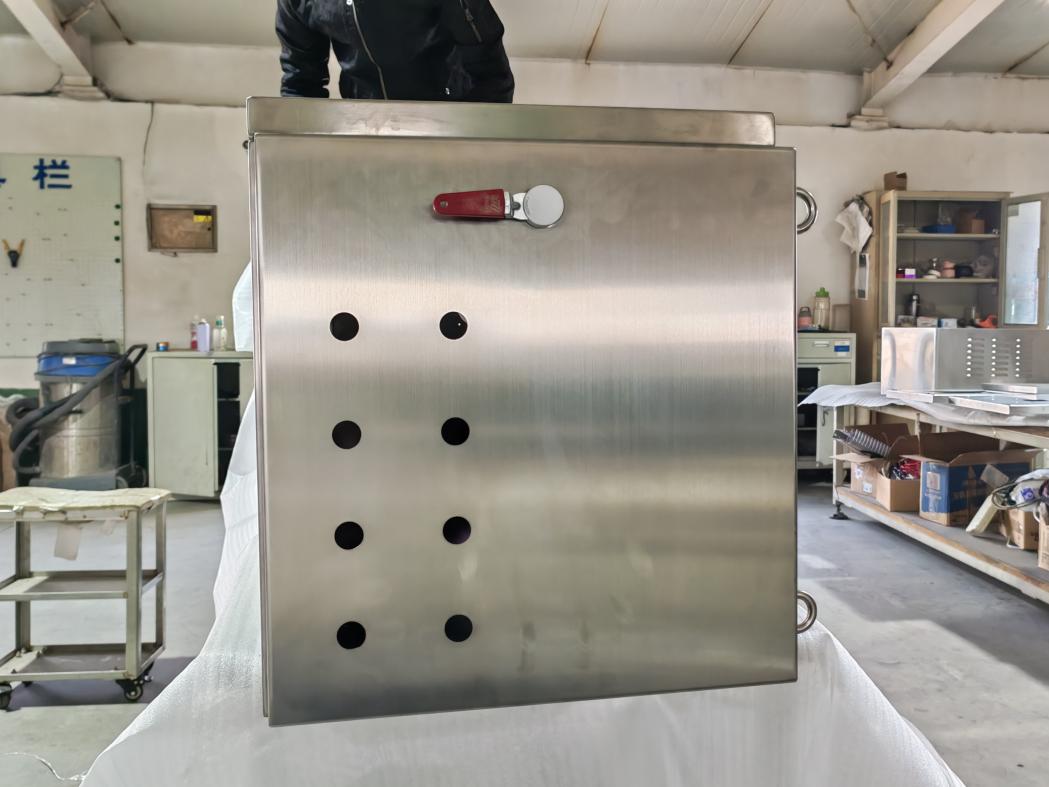
Door frame and seal detail: the EPDM strip and stainless hardware are the parts that decide whether the body stays sealed.
What this cabinet does not solve
A correct material choice does not compensate for an incorrect installation, and buyers should be clear about the boundary. Stainless steel resists corrosion but is not maintenance-free in a chloride-rich environment: salt and dust that collect at seals, hinges and fasteners can still cause staining and crevice attack, so a wash-down routine at agreed intervals remains part of the specification.
Condensation control is a separate decision. The content unit for this cabinet does not list heaters or dehumidifiers, while the wider scenario guidance for stainless steel enclosures lists dehumidifiers and heaters among auxiliary equipment for high-humidity and condensing conditions. If the site has large temperature swings or persistent condensation, that requirement should be raised as an addition rather than assumed to be included.
Finally, the IP rating is a statement about a tested configuration, not a property of the material. Glands that do not match the cable, an opened knockout left unfilled, or a top penetration interface that is not sealed will all reduce the ingress protection actually achieved on site, regardless of what the enclosure is rated for.
Frequently asked questions
Does an IP65 rating make this cabinet equivalent to a NEMA enclosure type?
No. NEMA enclosure types address additional hazards beyond the IP system, including corrosion, rust, icing, oil and coolants, and NEMA's technical bulletin states that there is not complete equivalency between NEMA enclosure types and IP ratings. If your project requires a NEMA type, specify the NEMA requirement alongside the IP requirement and ask the supplier for the applicable evidence, rather than converting one rating into the other.
Should a coastal project specify 304 or 316 stainless steel?
Yinlu's stainless steel scenario guidance distinguishes 304 stainless steel for general scenarios from 316 stainless steel for coastal and chemical scenarios, both with salt spray and acid-base resistance and a brushed or polished finish. For a coastal port, offshore platform or chemical park, 316 is the grade the guidance points to; for general outdoor and industrial duty, 304 is the stated baseline. The double-door cabinet described here is stainless steel with a 2.0 mm plate and a brushed finish, so the grade must be written explicitly on the enquiry and confirmed in the order documentation.
Can the cabinet hold 19-inch equipment, batteries or a PLC, and can the cable entry be customized?
Yes. The cabinet has built-in 19-inch mounting rails and uprights and is stated as compatible with communication equipment, energy storage batteries, PLCs and frequency converters, with an internal grounding bar and reserved top space for lighting and cable routing. Cable entry is through pre-drilled knockout holes at the bottom and back, configurable with stainless steel waterproof cable glands, with a cable and pipe penetration interface reserved at the top. Because the product is a non-standard custom build, the internal layout, cutouts and gland sizes are confirmed against the project's equipment list and cable schedule.
What should be inspected when the cabinet arrives on site?
Check that the EPDM sealing strip is continuous and correctly seated in the door frame, that both stainless steel handle locks operate with their keys, and that the door-to-cabinet grounding bond is present. Confirm the knockouts are undistorted and that any factory-fitted glands match the cable diameters, that the 19-inch rails or mounting plates and the internal grounding bar are installed as ordered, and that the brushed finish is free of transit scratches. Also verify that the protection rating stated on the documentation matches the rating on the purchase order.
How do I request a quotation for a coastal or chemical project?
Send the site environment (coastal, offshore, chemical or general outdoor), the required ingress protection and any NEMA requirement, the required stainless steel grade and plate thickness, the internal equipment list including any 19-inch rack items, the cable schedule with gland sizes, and the installation method. Yinlu then confirms the build, the drawing and the documentation set against those inputs. Enquiries can be sent to Sales@innometalfab.com or by phone and WhatsApp on +86 186-2435-1618; the company profile is available at innometalfab.com.
Conclusion
Corrosion on coastal and chemical sites is decided long before the first rust stain appears: it is decided by the grade of steel, the continuity of the seal, the way cables enter the body and the way the door is bonded and locked. Yinlu's stainless steel double-door outdoor cabinet addresses those points directly — a 2.0 mm brushed stainless steel body, a double-door front with stainless steel handle locks and an EPDM sealing strip, 19-inch internal mounting, pre-drilled knockouts with optional stainless waterproof cable glands, and floor mounting for communication, energy storage and industrial control equipment. Confirm the grade, the IP rating and the ventilation arrangement for your site, and the cabinet becomes a long-term part of the installation rather than a recurring maintenance item.

Project builds are configured from the site exposure, equipment list and cable schedule.
Next step: share your site conditions, required stainless steel grade, IP or NEMA requirement, equipment list and cable schedule with Yinlu to receive a configured quotation for a stainless steel double-door outdoor cabinet. Contact: Sales@innometalfab.com | +86 186-2435-1618 (phone and WhatsApp). Company profile: innometalfab.com. Product and capability brochure: download the PDF catalog.
Have Questions or Need More Details?
Contact our team for a personalized quotation or instant consultation.
Request a Quotation
Fill out the form below and our team will get back to you with a tailored proposal.
WhatsApp Direct Chat
Prefer to chat in real-time? Message us on WhatsApp for instant assistance & quick answers.
- Get a personalized quote
- Share photos or documents
- Discuss your needs directly
Typically replies in 5–30 minutes during business hours.