
IP Ratings, Steel Thickness, and Sealing: Technical Specs for Custom Control Boxes
A custom control box is defined by three specifications that rarely make it onto the first RFQ: sheet-metal thickness, surface treatment, and sealing. Those three parameters decide whether an enclosure keeps dust and water away from a PLC, a variable frequency drive, or a bank of breakers for years — or whether it corrodes, leaks, and forces an early replacement.
This guide breaks down the engineering specifications behind custom electrical control boxes: cold-rolled steel plate measured at 2.0 mm and above, brushed versus phosphated surface treatments, protection levels running from IP54 to IP65, and the EPDM sealing strips, door locks, and grounding bonds that turn a protection rating into a physical reality. Every figure below is drawn from documented product data covering wall-mounted control boxes, gym equipment control boxes, and related enclosure families.
The short answer: plate thickness sets structural strength and door alignment; surface treatment sets corrosion life; and the protection level sets what the box can survive. The IP rating is not achieved by the sheet metal alone — it is achieved by the gasket, the lock, the door geometry, and the grounding bond working together.
Why Enclosure Specifications Get Decided Too Late
Most custom control box projects start with a wiring diagram, a footprint, and a component list. The enclosure is then treated as a container rather than an engineered part of the system. That is the point at which specification gaps appear, and they tend to appear in the same three places.
- A wall-mounted box is ordered without a protection level. The box is delivered, installed beside a wash-down area or on a semi-exposed wall, and the buyer discovers that the gasket arrangement does not match the environment.
- Surface treatment is chosen on appearance. A brushed panel is selected for its finish, then placed outdoors where UV exposure, rain, and airborne acidity attack the enclosure over time.
- The door is sealed but not bonded. An EPDM strip is fitted, yet no grounding bond is specified between the door and the cabinet body, so electrical continuity across the door depends on hinges alone.
Each of these is a specification decision, not a manufacturing defect. They are also inexpensive to fix at the quotation stage and expensive to fix after installation.
The Market Context Behind Enclosure Specifications
Published market estimates for control panels vary widely because the category is scoped differently from report to report. Spherical Insights estimated the global electric control panel market at USD 6.35 billion in 2024. Dataintelo projected a broader definition of the electrical control panel market growing from USD 27.2 billion in 2025 to USD 47.0 billion by 2034. The gap between these figures reflects different product boundaries rather than contradictory demand signals.
On the component side, SNS Insider valued the global programmable logic controller (PLC) market at USD 12.95 billion in 2023, with a projected path to USD 22.61 billion by 2032. The practical reading for a buyer is straightforward: as more equipment is placed under automated control, more enclosures are specified, and the enclosure stops being a commodity accessory.
The reference point for assembly requirements is IEC 61439-1:2020, the primary international standard for low-voltage switchgear and controlgear assemblies, which defines general definitions, construction requirements, and verification methods. Buyers who specify enclosure parameters in the same terms used by that standard are easier to quote accurately and easier to audit later.
The Three Specifications That Define a Custom Control Box
1. Steel Thickness: The Number That Sets Structural Limits
Plate thickness is usually expressed in millimetres and appears in the material specification of every enclosure. Across the documented product range, 2.0 mm is the most common baseline for general-purpose control boxes, while heavier-duty assemblies move upward.
2.0 mm cold-rolled steel — Custom Wall-mounted Electrical Control Box / Local Operation Box; Gym Smart Equipment Control Box; Stainless Steel Distribution Box / PLC Control Cabinet; VFD Control Cabinet.
2.1 mm — Small Customized Electrical Control Box, built on 304 stainless steel.
2.5 mm — Low-voltage Switchgear / Power Distribution Cabinet, cold-rolled steel.
3.0 mm — Airport Ground Power Control Cabinet / Aviation Maintenance Distribution Box; Industrial Socket Box.
1.5–2.0 mm — Mobile Industrial Control & Equipment Mounting Base, available in cold-rolled steel and in 304/316 stainless steel.
What thickness actually controls is deflection and door behaviour. A heavier gauge resists panel flex when the enclosure is mounted, carries heavier internal assemblies without vibration-related movement, and holds door alignment so the gasket compresses evenly along its whole length. The trade-off is weight and handling: a 3.0 mm floor-standing cabinet with a compartment layout weighs considerably more than a 2.0 mm wall-mounted box, which matters for wall fixing, lifting points, and installation labour.
The Port Crane Control Cabinet illustrates how tight the manufacturing side can get: it is built in 316L stainless steel with a hole tolerance of ≤±0.5 mm and a top load-bearing capacity of ≥50 kg. Tolerance at that level is what allows a multi-door enclosure to close consistently on a gasket.
2. Surface Treatment: Brushing Versus Phosphating Plus Powder Coating
Surface treatment determines how long the substrate survives its environment, and the documented range uses two distinct approaches.
Brushed finish is applied to the Custom Wall-mounted Electrical Control Box / Local Operation Box, the Stainless Steel Distribution Box / PLC Control Cabinet, and the Small Customized Electrical Control Box. In the case of the small customized box, the brushed finish on 304 stainless steel is described as easy to clean and corrosion resistant. The protective layer here is the alloy itself plus a mechanical surface; there is no applied coating to chip.
Phosphating derusting plus electrostatic powder coating is applied to the Gym Smart Equipment Control Box, the VFD Control Cabinet, the Airport Ground Power Control Cabinet, the Industrial Socket Box, and the Low-voltage Switchgear / Power Distribution Cabinet. In this system, phosphating prepares and de-rusts the cold-rolled steel surface, and the electrostatic powder coating forms the finished layer. Standard colour on the VFD Control Cabinet and the Low-voltage Switchgear is RAL7035 light grey.
The Mobile Industrial Control & Equipment Mounting Base documents both paths side by side: cold-rolled steel versions receive electrostatic powder coating with customizable colours (default RAL7035 light grey), while stainless steel versions receive a brushed or polished finish described as corrosion-resistant and anti-fingerprint.
One further variant matters for outdoor installations. The Low-voltage Switchgear specifies a UV-resistant coating suitable for outdoor exposure, and the Custom Wall-mounted Electrical Control Box is specified as UV-resistant, anti-aging, and acid rain-proof, suitable for long-term outdoor exposure to sunlight, rain, and snow.
3. IP Ratings Explained from IP54 to IP65
In the IP code system, the first digit addresses protection against solid objects and dust, and the second digit addresses protection against water. The documented enclosure range spans IP54, IP55, IP65, and, on one product family, optional IP44 through IP67.
| Protection level | Where it appears in the documented range | Typical installation context |
|---|---|---|
| IP54 | Gym Smart Equipment Control Box | Indoor wall-mounted power control for fitness equipment |
| IP55 | Small Customized Electrical Control Box (upgradable to IP65); Low-voltage Switchgear / Power Distribution Cabinet; Airport Ground Power Control Cabinet; Port Crane Control Cabinet | Dustproof and splash-proof workshop, apron, and heavy-equipment environments |
| IP65 | Custom Wall-mounted Electrical Control Box / Local Operation Box; Stainless Steel Distribution Box / PLC Control Cabinet; optional on the VFD Control Cabinet for outdoor, waterproof and dustproof scenarios | Outdoor or wash-down exposure; dust-tight and water-jet resistant |
| IP44 / IP55 / IP67 | Industrial Socket Box (optional) | From general workshop use through heavy-rain-exposed temporary power supply |
Two points are worth noting when comparing quotations. First, the same enclosure family can often be upgraded: the Small Customized Electrical Control Box is specified at IP55 for workshop sites and is upgradeable to IP65 for outdoor scenarios, while the VFD Control Cabinet is specified at IP54/IP55 for indoor use with IP65 available as an option for outdoor, waterproof and dustproof scenarios. Second, a higher rating is not automatically the right answer — it usually comes with a tighter seal, which changes how heat leaves the enclosure.
4. Sealing Components: EPDM Strips, Door Locks, and Grounding Bonds
An IP rating is delivered by hardware, not by a label. Three components carry most of the load.
EPDM sealing strips. EPDM (Ethylene Propylene Diene Monomer) appears as the standard sealing material across the documented range: the Custom Wall-mounted Electrical Control Box and the Stainless Steel Distribution Box both specify an EPDM sealing strip on the door frame; the Gym Smart Equipment Control Box specifies an EPDM seal on the door frame; the VFD Control Cabinet specifies an EPDM rubber seal on the door frame; the Mobile Industrial Control & Equipment Mounting Base specifies an EPDM rubber seal for dust and water protection; and the Low-voltage Switchgear specifies an EPDM rubber seal for high tightness. The Port Crane Control Cabinet uses a different, higher-duty arrangement — a double-seal with a silicone rubber seal strip.
Door locks. The closing hardware is what compresses the gasket, so lock type and gasket type belong in the same specification line. The Custom Wall-mounted Electrical Control Box and the Stainless Steel Distribution Box use a double-door design with a stainless steel handle lock supplied with keys. The Gym Smart Equipment Control Box uses a single door with a plane lock, or an optional password lock. The Small Customized Electrical Control Box uses a single-door design with a stainless steel flat lock. The Low-voltage Switchgear uses double doors with heavy-duty hinges and MS lever locks.
Grounding bonds. A gasketed, painted door is a poor conductor. The Custom Wall-mounted Electrical Control Box and the Stainless Steel Distribution Box therefore specify reliable grounding bonding between the door and the cabinet body, and an internal grounding bar is included. Across the wider range, a grounding resistance of ≤4 Ω is specified for the Gym Smart Equipment Control Box, the VFD Control Cabinet, the Stainless Steel Electrical Control Cabinet, the Industrial Socket Box, the Low-voltage Switchgear, and the Airport Ground Power Control Cabinet, which also specifies equipotential terminals.
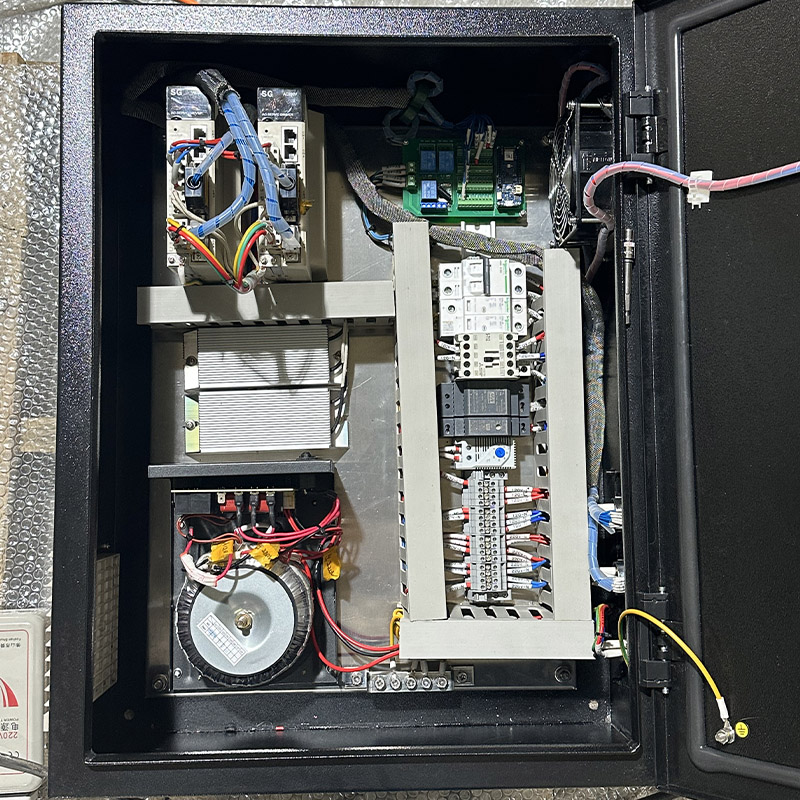
Gym Smart Equipment Control Box: 2.0 mm cold-rolled steel, phosphating plus electrostatic powder coating, IP54, wall-mounted, EPDM seal on the door frame.
Step-by-Step: How to Specify a Custom Control Box
- Define the environment first, not the size. Indoor gym floor, workshop wall, outdoor pole, coastal apron, or high-altitude site. Temperature, humidity, UV, and salt exposure all translate directly into specification lines. The Airport Ground Power Control Cabinet, for example, is rated for −20 °C to +60 °C with an altitude limit of ≤4000 m, and the 316 stainless version of the Stainless Steel Electrical Control Cabinet extends to −40 °C to +80 °C.
- Set the protection level from the worst condition. Choose the IP rating that matches the harshest moment the box will face, then confirm whether an upgrade path exists — IP55 to IP65 on the small customized box, or IP54/IP55 indoor to IP65 outdoor on the VFD Control Cabinet.
- Choose the substrate and thickness. Cold-rolled steel at 2.0 mm covers most indoor and sheltered installations. Move to 2.5 mm or 3.0 mm for larger floor-standing assemblies, and to 304, 316, or 316L stainless steel where corrosion is the dominant risk.
- Choose the surface treatment. Brushed finish for stainless steel panels where appearance and cleanability matter; phosphating plus electrostatic powder coating for cold-rolled steel where colour consistency and coating durability matter. Confirm UV resistance if the box is exposed to direct sun.
- Specify door hardware and sealing. State the lock type (stainless steel handle lock with keys, flat lock, plane lock, or password lock), the gasket material (EPDM as standard, silicone in a double-seal arrangement), and the number of doors.
- Specify the grounding arrangement. Require a door-to-body grounding bond and an internal grounding bar, and state the grounding resistance target — ≤4 Ω appears as the standard across the documented range.
- Specify internal configuration and cable entry. DIN rails, mounting plates, 19-inch rails or uprights, terminal blocks, and MCB/RCD modules are the common internals. Cable entry is typically pre-drilled knockout holes at the bottom or back with waterproof cable glands, plus reserved penetration interfaces at the top on some models.
- Confirm thermal management. A sealed box traps heat. Documented options include internal heat dissipation louvers, back and side heat dissipation louvers, and optional axial fans with filter mesh to prevent dust ingress; the VFD Control Cabinet additionally offers a heat exchanger, an industrial air conditioner, and a temperature control module.
Use Cases: How These Specs Play Out in Practice
Fitness facilities and gym equipment control
The Gym Smart Equipment Control Box is a wall-mounted, single-door enclosure in 2.0 mm cold-rolled steel with phosphating derusting plus electrostatic powder coating and an IP54 rating. It operates at AC 220 V with rated currents of 16 A, 32 A, or 63 A depending on the total power of the gym equipment, and includes overload, short-circuit, and leakage protection with optional over/under voltage protection. Internally it integrates DIN rails, terminal blocks, a grounding bar, and MCB/RCD modules, and can host relays, PLC components, and smart control modules for timer switching, WiFi or 4G remote control, equipment linkage, and energy consumption monitoring. Typical controlled loads include treadmills, elliptical machines, strength equipment, lighting, air conditioning, and access control.
Industrial automation and processing equipment
The Small Customized Electrical Control Box — also described as a local operation box, on-site equipment control box, or PLC control box — uses 2.1 mm 304 stainless steel with a brushed finish at IP55, upgradeable to IP65 for outdoor scenarios. It is designed for wall-mounted or equipment side-mounted installation and is applied to industrial automation equipment, packaging machinery, food machinery, water treatment equipment, testing equipment, and special purpose machine tools.
Outdoor and weather-exposed control points
The Custom Wall-mounted Electrical Control Box / Local Operation Box combines 2.0 mm cold-rolled steel, a brushed finish, and IP65 protection with a double-door design, an EPDM door-frame seal, door-to-body grounding bonding, and weather resistance described as UV-resistant, anti-aging, and acid rain-proof. Its internal configuration accommodates 19-inch mounting rails or uprights, communication equipment, energy storage batteries, PLC components, and frequency converters.
Drive and motor control cabinets
The VFD Control Cabinet is built from 2.0 mm cold-rolled steel with phosphating derusting plus electrostatic powder coating in RAL7035, floor-standing, with a depth range of 500–800 mm and an ambient temperature range of 10 °C to +55 °C. Protection is IP54/IP55 for indoor use with IP65 available for outdoor, waterproof and dustproof scenarios. Vibration resistance complies with GB/T 13384.
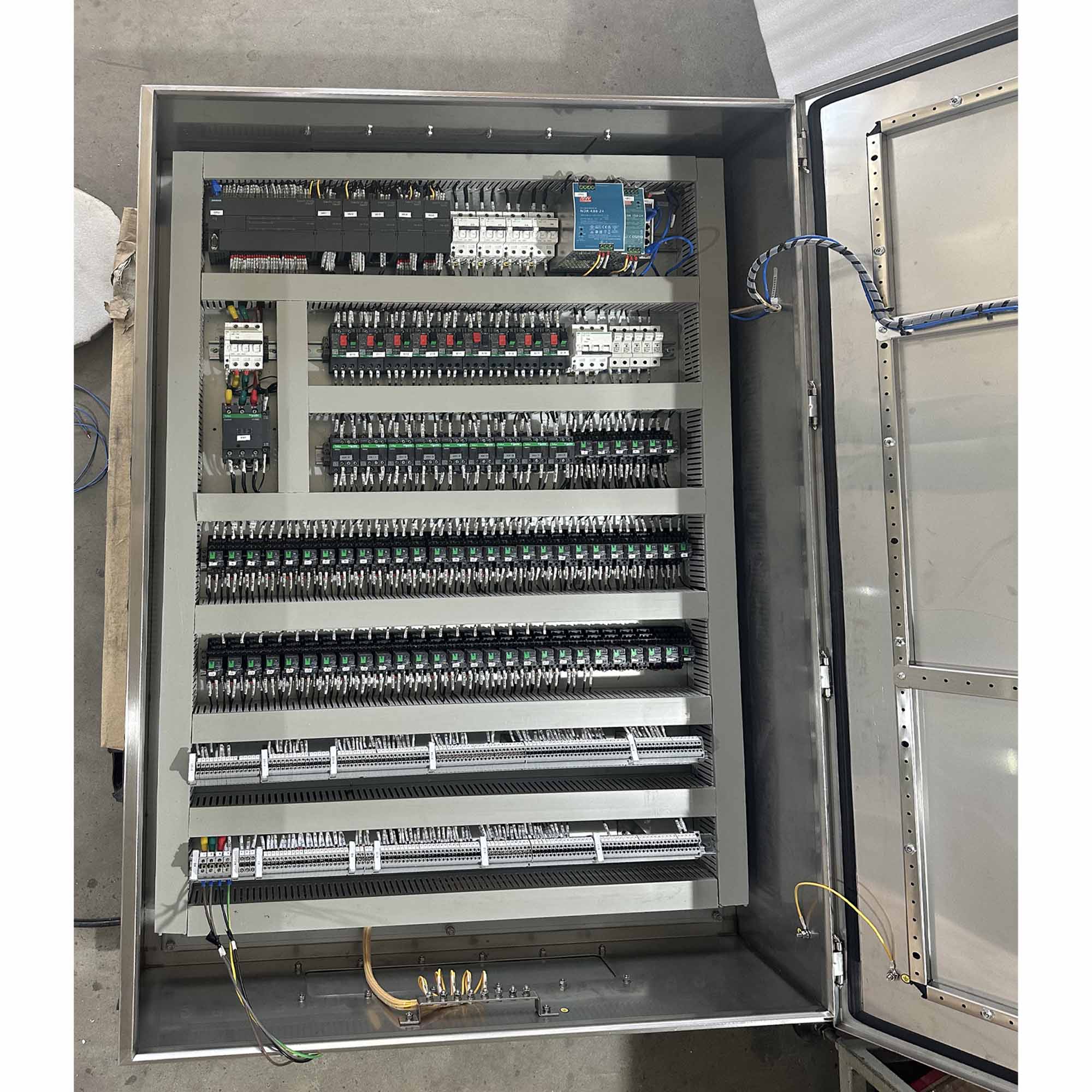
Stainless Steel Distribution Box / PLC Control Cabinet: 2.0 mm plate, brushed finish, IP65, double door with EPDM sealing strip and door-to-body grounding bond.
Corrosive, coastal, and heavy-duty environments
The Port Crane Control Cabinet is specified in 316L stainless steel at IP55 with a double-seal and silicone rubber seal strip, a salt spray performance of 1.5 g compliant with GB/T 2423.10, a service life of ≥15 years, a hole tolerance of ≤±0.5 mm, a top load-bearing capacity of ≥50 kg, and a compatible circuit breaker current of up to 6300 A with phase-to-phase insulation resistance of ≥100 MΩ.
Custom Control Box Specification Comparison
The table below compares documented enclosure families on the four parameters that most often decide a sourcing choice.
| Product | Plate thickness | Surface treatment | Protection level | Door, lock and sealing |
|---|---|---|---|---|
| Custom Wall-mounted Electrical Control Box / Local Operation Box | 2.0 mm (cold-rolled steel) | Brushed finish | IP65 | Double door; stainless steel handle lock with keys; EPDM sealing strip; door-to-body grounding bond; optional bottom ventilation louver |
| Stainless Steel Distribution Box / PLC Control Cabinet | 2.0 mm (316 stainless steel) | Brushed finish | IP65 | Double door; stainless steel handle lock with keys; EPDM sealing strip; door-to-body grounding bond |
| Gym Smart Equipment Control Box | 2.0 mm (cold-rolled steel) | Phosphating derusting + electrostatic powder coating | IP54 | Single door; plane lock or optional password lock; EPDM seal on door frame; internal heat dissipation louver |
| Small Customized Electrical Control Box | 2.1 mm (304 stainless steel) | Brushed finish | IP55, upgradeable to IP65 | Single door; stainless steel flat lock; grounding bar included |
| VFD Control Cabinet | 2.0 mm (cold-rolled steel) | Phosphating derusting + electrostatic powder coating, RAL7035 | IP54/IP55 indoor; IP65 optional | Single or double door; stainless steel handle lock; EPDM rubber seal on door frame; observation window or heat dissipation louver optional |
| Low-voltage Switchgear / Power Distribution Cabinet | 2.5 mm (cold-rolled steel) | Phosphating + electrostatic powder coating, RAL7035, UV-resistant | IP55 | Double doors; heavy-duty hinges; MS lever locks; EPDM rubber seal for high tightness |
| Airport Ground Power Control Cabinet / Aviation Maintenance Distribution Box | 3.0 mm (cold-rolled steel) | Phosphating derusting + electrostatic powder coating | IP55 | Floor-standing, movable version with casters; compartment design for power, control and maintenance |
| Industrial Socket Box | 3.0 mm (cold-rolled steel) | Phosphating + electrostatic powder coating | IP44 / IP55 / IP67 optional | Single door with lock catch; waterproof sealing strip; optional transparent observation window |
| Port Crane Control Cabinet (YL251009-1) | 316L stainless steel | Corrosion-resistant stainless construction | IP55 (double-seal + silicone rubber seal strip) | Salt spray 1.5 g per GB/T 2423.10; service life ≥15 years; hole tolerance ≤±0.5 mm |
Conversion and Delivery: Turning Specs into a Buildable Order
Specifications only matter if they can be manufactured consistently. Dalian Yinlu Electrical Control Equipment Manufacturer is a company established in 1993 with over 30 years of operational experience, specializing in the manufacturing of electrical control boxes, cabinets, operation panels, and non-standard housings, focused on metal enclosure customization. Its manufacturing facility covers 5000 m² with an annual production capacity of approximately 20,000 units, supported by a workforce of about 60 staff and an R&D team of 6 engineers. Around 80% of products are exported to markets including North America, Europe, Oceania, and the high-end Asia-Pacific region.
For buyers, that structure matters at the point where a 2.0 mm plate, a specified gasket, and a stated IP rating have to survive a production run rather than a single prototype. Enclosure customization also means thickness, finish, colour, door configuration, and internal layout are all quotable variables rather than fixed catalogue options.
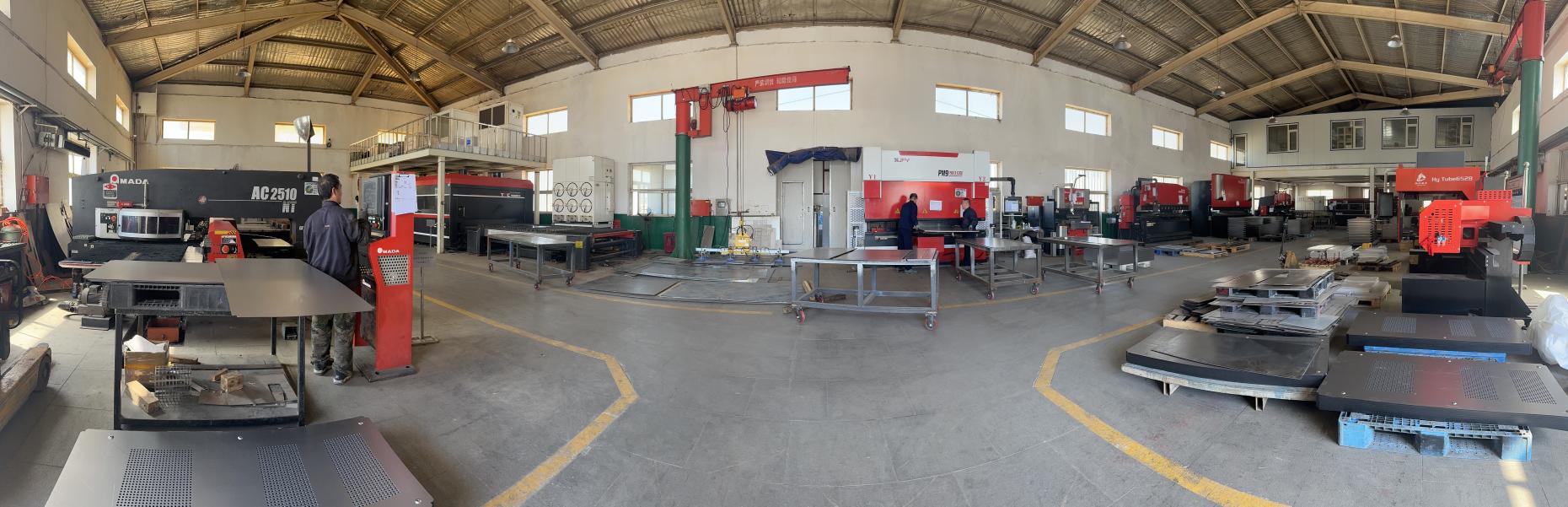
Sheet metal fabrication equipment used for enclosure customization — plate forming, cutting, and preparation ahead of surface treatment.
FAQ: Technical Specs for Custom Control Boxes
What IP rating does a custom control box actually need?
The rating should match the harshest condition the enclosure will face, not the average one. In the documented range, IP54 is used for the wall-mounted Gym Smart Equipment Control Box, IP55 for the Small Customized Electrical Control Box, the Low-voltage Switchgear, the Airport Ground Power Control Cabinet, and the Port Crane Control Cabinet, and IP65 for the Custom Wall-mounted Electrical Control Box / Local Operation Box and the Stainless Steel Distribution Box / PLC Control Cabinet. Upgrades are often possible within the same family: the small customized box is IP55 upgradeable to IP65, and the VFD Control Cabinet is IP54/IP55 for indoor use with IP65 available for outdoor, waterproof and dustproof scenarios.
How thick should the steel be on a custom control box?
2.0 mm cold-rolled steel is the baseline for most general-purpose control boxes and appears on the Custom Wall-mounted Electrical Control Box, the Gym Smart Equipment Control Box, the Stainless Steel Distribution Box / PLC Control Cabinet, and the VFD Control Cabinet. The Small Customized Electrical Control Box uses 2.1 mm 304 stainless steel, the Low-voltage Switchgear uses 2.5 mm, and the Airport Ground Power Control Cabinet and the Industrial Socket Box use 3.0 mm. Thicker plate resists deflection and carries heavier internal assemblies, but it also increases weight and handling requirements.
What do EPDM strips, door locks, and grounding bonds actually do?
The EPDM strip is the compressible seal that closes the gap between door and frame; it appears on the Custom Wall-mounted Electrical Control Box, the Stainless Steel Distribution Box, the Gym Smart Equipment Control Box, the VFD Control Cabinet, the Low-voltage Switchgear, and the Mobile Industrial Control & Equipment Mounting Base. The lock applies the closing force that compresses that seal — stainless steel handle locks, flat locks, plane or password locks, and MS lever locks are all used across the range. The grounding bond maintains electrical continuity between door and cabinet body so that a gasketed, coated door does not break the earth path; grounding resistance is specified at ≤4 Ω across several enclosure families.
Can thickness, finish, and protection level be changed on a custom order?
Yes. Enclosure customization in this range covers plate thickness, substrate (cold-rolled steel, 304, 316, or 316L stainless steel), surface treatment (brushed finish or phosphating plus electrostatic powder coating), colour (RAL7035 light grey as standard, with customizable colours such as RAL7021 dark grey), protection level upgrades, and door configuration. The Mobile Industrial Control & Equipment Mounting Base documents split-type or integrated structures and any size customization based on equipment cab space, operation habits, and component quantity, with an operating temperature range of −10 °C to +60 °C and a customizable extension from −40 °C to +85 °C.
Where can I review the full specification range before quoting?
The complete product catalogue covers wall-mounted and floor-standing control boxes, stainless steel distribution boxes, VFD control cabinets, low-voltage switchgear, industrial socket boxes, airport ground power cabinets, and port crane control cabinets, with plate thickness from 2.0 mm through 3.0 mm and protection levels from IP44 to IP67 depending on configuration. You can download the PDF catalogue here: Dalian Yinlu product catalogue. For a specification review against a specific project environment, contact the team at innometalfab.com or email Sales@innometalfab.com.
Conclusion
Custom control box specifications come down to a short list of decisions. Plate thickness — 2.0 mm as the general baseline, rising to 2.5 mm and 3.0 mm for larger or heavier assemblies — sets structural behaviour and door alignment. Surface treatment, whether brushed stainless steel or phosphating plus electrostatic powder coating, sets corrosion life and appearance. The IP rating, from IP54 through IP65 and up to optional IP67, sets what the enclosure can survive. And the EPDM strip, the door lock, and the door-to-body grounding bond are what make that rating physically true.
Specify all four together, in the same RFQ, and the enclosure stops being an afterthought to the wiring diagram.
Next step: get your enclosure specification reviewed
Share your environment, component list, and required protection level, and received feedback on plate thickness, surface treatment, sealing arrangement, and internal layout for a custom control box.
Download the product catalogue (PDF) | Visit innometalfab.com | WhatsApp: +86 186-2435-1618
Have Questions or Need More Details?
Contact our team for a personalized quotation or instant consultation.
Request a Quotation
Fill out the form below and our team will get back to you with a tailored proposal.
WhatsApp Direct Chat
Prefer to chat in real-time? Message us on WhatsApp for instant assistance & quick answers.
- Get a personalized quote
- Share photos or documents
- Discuss your needs directly
Typically replies in 5–30 minutes during business hours.