
IP65 Wall Box vs Stainless PLC Cabinet: Lifecycle Guide
Short answer: an IP65 wall-mounted box and a stainless steel PLC cabinet can hold the same PLC, the same variable frequency drive and the same terminal blocks, so the decision is not about electrical capability. It is about installation position, how often the enclosure is opened, and how the line will be serviced years after commissioning. The wall-mounted box fits machine-level local operation in a compact, dust-exposed position. The stainless steel cabinet fits larger PLC and VFD arrays that need 19-inch organisation, double-door access and better corrosion resistance.
This comparison covers construction and sealing, the applications each configuration suits, the ownership and repeat-build factors that appear after year one, and the purchasing and acceptance questions worth settling before the drawing is released.
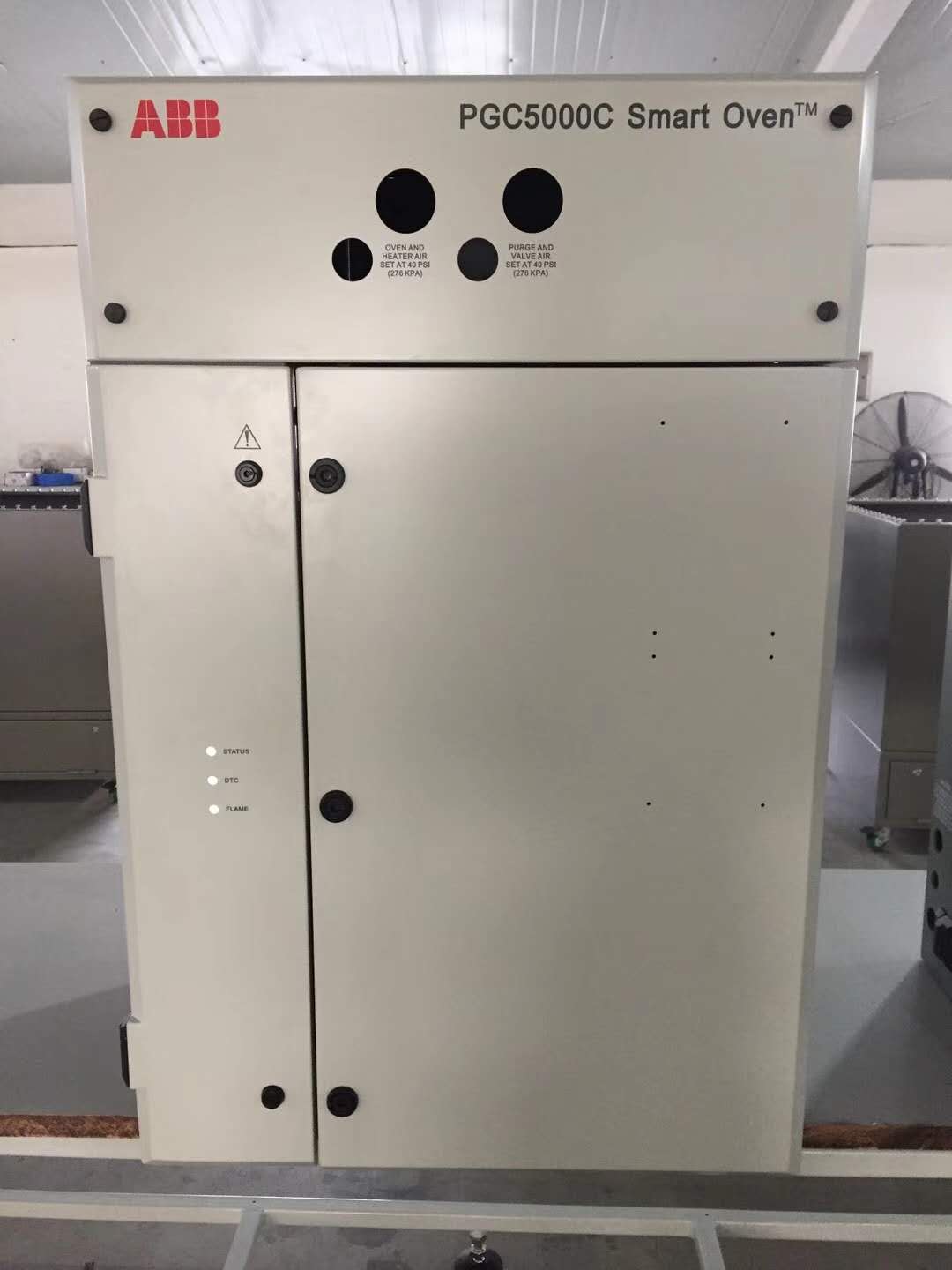
The decision most control panel enquiries postpone
Most enquiries lead with the electrical content — PLC model, drive ratings, I/O count — and treat the enclosure as a secondary line on the quotation. In service, that single line decides more of the operating experience than any other item on the bill of materials.
Four variables normally settle the choice between a wall-mounted box and a cabinet:
- Environment: dust, water jets, cleaning routine, corrosive atmosphere, indoor or outdoor position.
- Control content: number of drives, depth required, heat load, and whether 19-inch equipment is involved.
- Access pattern: whether an operator touches the panel every shift or only a technician during commissioning and maintenance.
- Service life: how the panel will be re-ordered, documented and supported over the following years.
A control panel enclosure is not a passive box. It sets the cooling path, the cable-entry discipline, how cleanable the surface is, and how much room a technician has while tracing a fault. Choosing between a wall-mounted box and a stainless cabinet is therefore a choice about maintenance and lifecycle cost rather than about which one looks stronger.
Industry background: more panels in service, longer support horizons
Two market data points frame the decision. Research and Markets estimated the global electrical control panel market at USD 60.4 billion in 2026 and projected USD 98.6 billion by 2036, a 5.0% CAGR (published October 2026). Custom Market Insights placed Asia Pacific above 38% of 2026 revenue and sized the low-voltage distribution panel segment at USD 1.8 billion for 2026, rising to USD 2.9 billion by 2035 at a 5.9% CAGR.
Standards add a second constraint. UL Solutions describes UL 508A as the benchmark for industrial control panels in North America and IEC 61439 as the international assembly standard. The destination market therefore influences which documentation a buyer should request, alongside CE and RoHS evidence for European shipments.
For a buyer at decision stage the practical reading is narrow: every panel added to a plant becomes an asset that will be maintained and eventually replicated. Enclosure format, material and sealing are locked at design stage and are expensive to change later, while component-level choices can still be revised at the next build.
Option A: the IP65 wall-mounted box
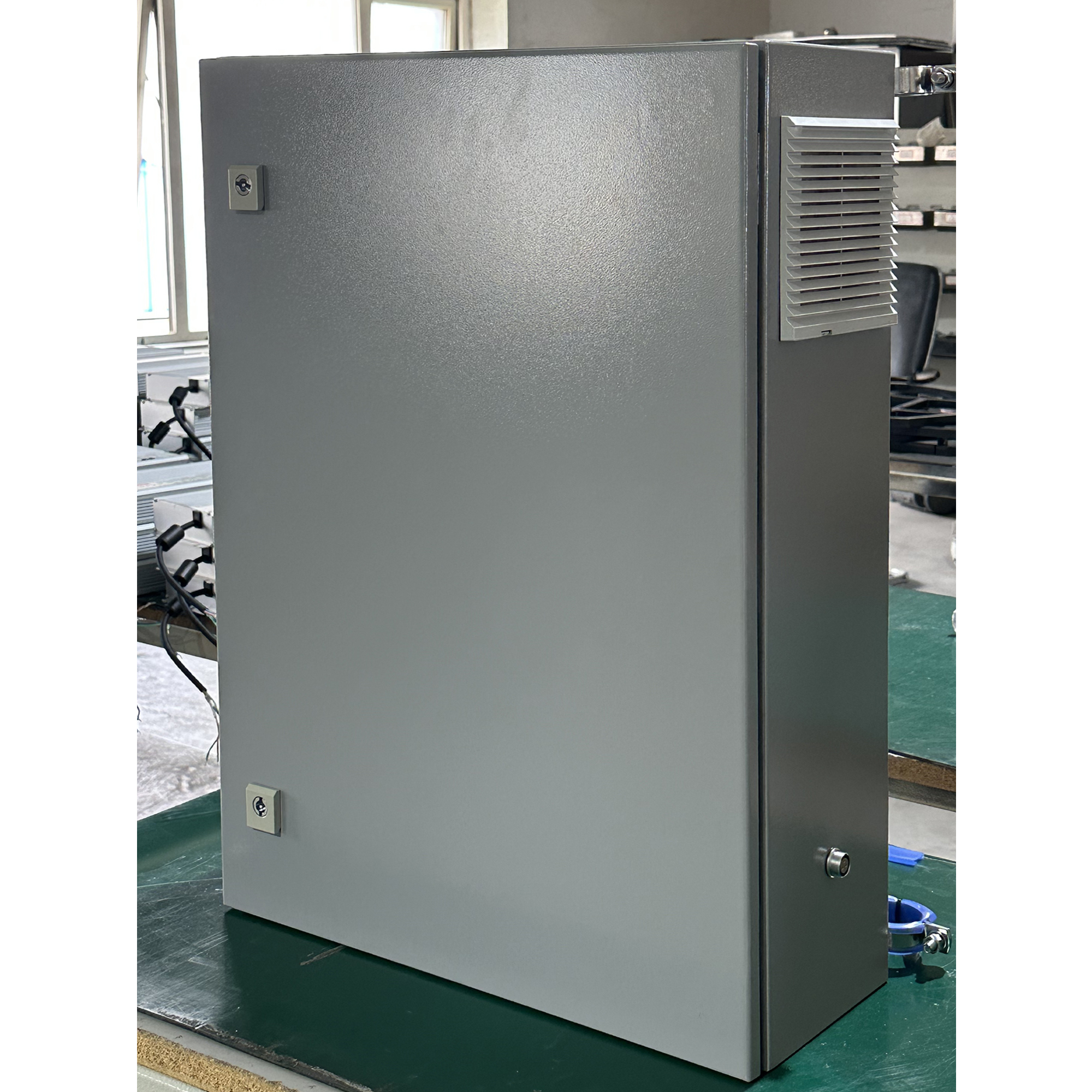
An IP65 wall-mounted box is a sheet metal control panel designed to sit at operator height, close to the machine it controls. The version compared here uses a 2.0 mm cold-rolled steel body, which gives the door, back plate and gland plate a rigid base without a separate frame.
What IP65 covers. IP65 means the enclosure is dust-tight and protected against water jets from any direction. For an industrial buyer that translates into dusty workshops, sheltered outdoor positions, and wash-down areas where water is sprayed rather than the enclosure being immersed.
Why the format is used. Wall mounting frees floor space, shortens cable runs to the machine and puts pushbuttons, selector switches and a small HMI at the height an operator actually works at. A wall-mounted box is also quicker to reposition on a line that may be rearranged.
Where the format stops. Internal volume is the limiting factor. There is one front access face, limited depth for drives, and less external surface for heat dissipation than a cabinet offers. When a panel carries several VFDs, a large PLC rack or a significant heat load, the box either grows past the size that suits wall mounting or the design moves to a cabinet.

Option B: the stainless steel PLC cabinet
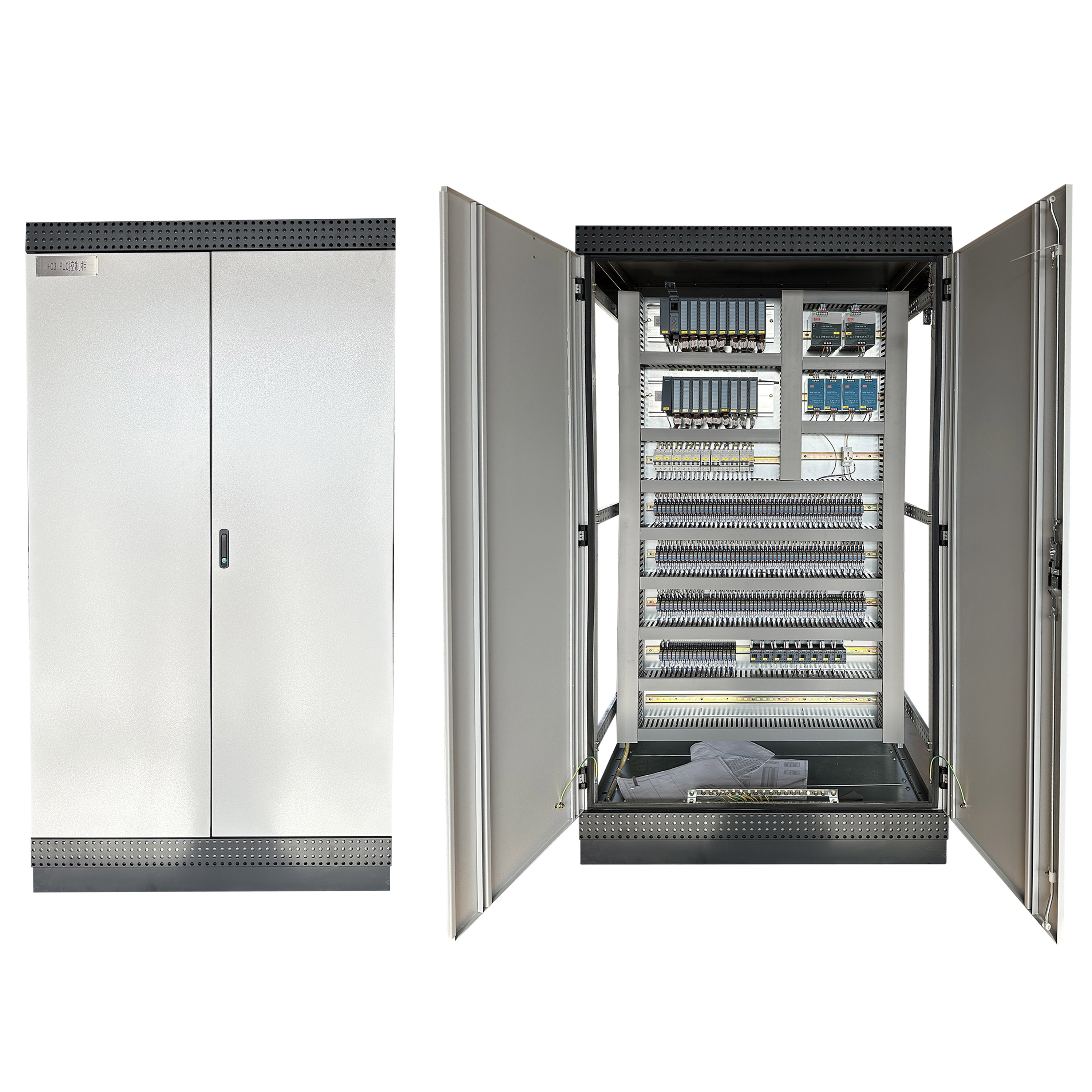
A stainless steel PLC cabinet handles a larger electrical content in an envelope built for corrosion exposure. The configuration compared here uses stainless steel with a brushed finish, double doors with EPDM sealing, and 19-inch mounting rails inside.
Brushed stainless steel. The brushed finish leaves a uniform, low-glare surface that is easier to clean than a coated surface and does not rely on paint for corrosion resistance. That is why stainless cabinets appear in food machinery, water treatment and other wet or chemically exposed areas.
Double doors and EPDM sealing. Two doors open the full internal width instead of a single swing, which matters when drives and terminal rows sit side by side. EPDM is a weather-resistant elastomer used for outdoor gaskets; the seal performs only while it stays under even compression, so door alignment, hinge setting and cable-entry sealing have to be verified at installation rather than assumed from the IP rating.
19-inch mounting rails. Rails give the PLC, I/O modules, drives, power supplies and network equipment a defined mounting plane. Components land in the same position in every cabinet, drawings stay valid between builds, and a replicated production line gets an enclosure that matches the first one.
Where the format stops. Footprint, weight and cable entry. A cabinet occupies floor or frame space, is harder to relocate once installed, and needs correctly sized gland plates to hold IP65.
Side-by-side comparison
| Comparison point | IP65 wall-mounted box | Stainless steel PLC cabinet |
|---|---|---|
| Enclosure role | Local operation and machine-level control | Central PLC, VFD and distribution content |
| Body construction | 2.0 mm cold-rolled steel | Stainless steel, brushed finish |
| Ingress protection | IP65 | IP65 |
| Doors and sealing | Front access door, IP65 sealed | Double doors with EPDM sealing |
| Internal mounting | Back-plate layout for control components | 19-inch mounting rails |
| Installation | Wall-mounted at operator level | Cabinet position with full-width access |
| Typical fit | Dusty workshops, outdoor machine positions, packaging and pump control | Food machinery, wet or corrosive areas, multi-drive panels, building power distribution |
| Main limit | Internal volume and heat dissipation | Footprint, weight, cable-entry discipline |
Step by step: how to specify either option
Both configurations are custom builds, so the specification process is the same and only the enclosure parameters change.
- Fix the environment and IP target in writing. Record whether the panel sits indoors, outdoors, in a wash-down zone or in a corrosive atmosphere. IP65 is a working target for dust and water jets; if the area is hosed at close range or exposed to chemical splash, material and sealing detail must be agreed before the drawing is released.
- Size the control content, not the box. List PLC, I/O count, drives, power supplies, terminals and any 19-inch equipment. That list decides whether a wall-mounted box has the depth and surface area, or whether the job needs 19-inch rails in a double-door cabinet.
- Decide mounting and access. Operator-facing controls belong at working height on a wall-mounted box; equipment opened for maintenance or commissioning belongs in a cabinet with full-width access. Access frequency, more than panel size, usually settles this.
- Match material to the corrosion exposure. Cold-rolled steel at 2.0 mm covers most indoor and sheltered outdoor positions. Stainless steel with a brushed finish is the choice where moisture, cleaning agents or corrosive atmosphere would attack a steel surface over time.
- Confirm doors, sealing and cable entry. Double-door EPDM sealing on a cabinet, single front access on a box, and gland plates sized to the actual cable schedule. Most IP65 problems at site trace back to cable entry rather than to the door gasket.
- Lock the build in a signed technical agreement. Voltage, power, current, IP rating, dimensions, material, interface and functions must all be confirmed in writing, with signed drawings and a stamped technical agreement. Verbal requests are not a valid basis for production.
Three documents that prevent most disputes. First, a component brand list naming brands such as Schneider, ABB, Chint or Delixi together with model numbers, country of origin and confirmation that parts are new and genuine, supported by purchase contracts, invoices and certificates of conformity. Second, a test plan: power-on functional test, insulation resistance test, withstand voltage test, grounding test, and appearance, dimension and labeling inspection, with shipment only after all tests pass. Third, an approved prototype for custom and key-account orders, so mass production is checked against a signed reference.
Applications: matching the enclosure to the job
Industrial automation and packaging machinery
Packaging and textile machinery usually need local operation at the machine plus a central control point. The wall-mounted box handles the operator interface and local control, while line-level PLC and drive content goes into a cabinet. Splitting the two keeps fault-finding local and avoids running every signal back to one large enclosure.
Food machinery
Food processing areas combine moisture, cleaning agents and hygiene requirements. A brushed stainless cabinet with double doors and EPDM sealing is the appropriate envelope where the panel stands inside the production area; a cold-rolled steel wall box suits positions outside the wet zone. IP65 addresses water jets, not immersion or close-range high-pressure cleaning, so the cleaning routine belongs in the enquiry.
Water treatment and environmental equipment
Pump stations, valve control and instrument loops are often outdoors or in wet rooms. A wall-mounted IP65 box at the pump position keeps control local and cable runs short, while the plant room concentrates PLC, VFD and distribution content in a stainless cabinet. Local operation and central coordination therefore sit in different enclosures within the same project.
Building power distribution
Where a project needs a modular distribution panel or a low-voltage electrical distribution panel feeding a building, cabinet format is the usual working assumption, because outgoing devices, busbar and cable space exceed what a wall box holds. An automatic control panel for pumps, HVAC or lighting can sit in the same line-up or in a smaller wall-mounted enclosure, depending on device count.
On-site maintenance and commissioning
Access decides downtime. Double doors and a modular internal layout let a technician reach a terminal row or replace a drive without dismantling the panel, and the same layout shortens commissioning because the wiring route is visible. A wall-mounted box opens quickly but leaves less room to work inside.
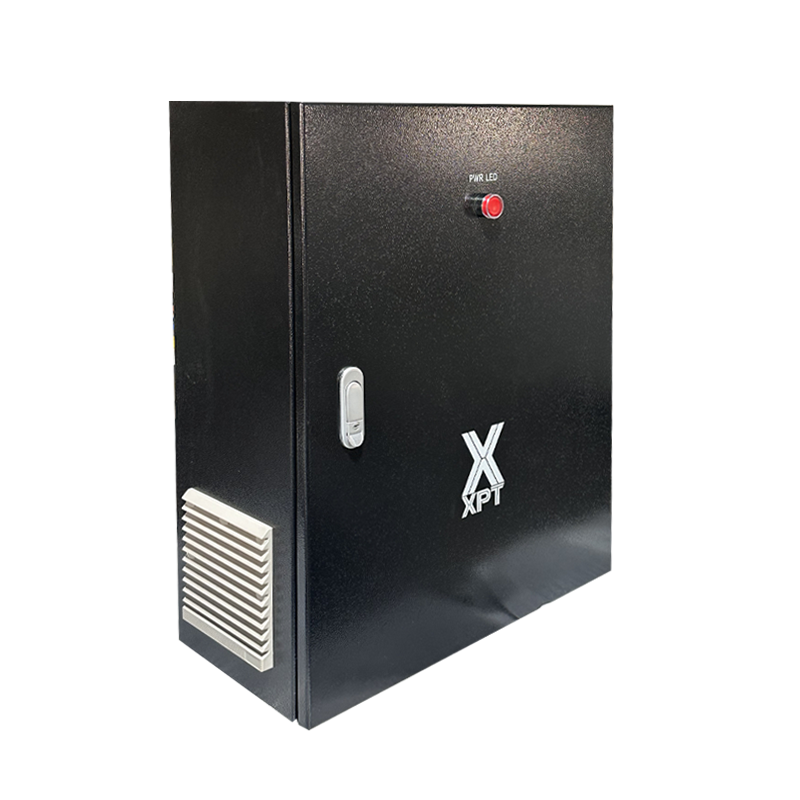
Long-term ownership, spares and supply continuity
Ownership cost is set by three things: how often the panel is maintained, how long the enclosure survives its environment, and whether the next identical panel can be built without re-engineering.
Maintenance and access
An easy-access structural design reduces maintenance frequency and shortens component replacement, while a modular internal layout simplifies troubleshooting and cuts downtime when a fault appears. In a double-door cabinet those benefits scale with panel size, because the full internal width stays reachable.
Material life and corrosion
Corrosion-resistant materials reduce wear on hinges, fasteners and gland plates as well as on the body. Where the environment attacks a steel surface, the stainless option protects the enclosure without depending on a coating that has to be maintained — a difference that shows up in the maintenance schedule rather than on the invoice.
Heat path and efficiency
Enclosure format shapes the heat path. Better heat dissipation and efficient ventilation reduce overheating risk and avoid energy wasted through avoidable losses, and stable power distribution supports equipment efficiency. A larger cabinet offers more surface area and more room for a planned airflow path, which is one reason multi-drive panels leave wall boxes behind.
Repeat builds and documentation
Signed drawings, component records and the approved prototype are what make a second order predictable; mass production is required to follow the approved prototype standard. For a multi-site rollout, that is the difference between a repeat build and a redesign.
Supplier capacity and export experience
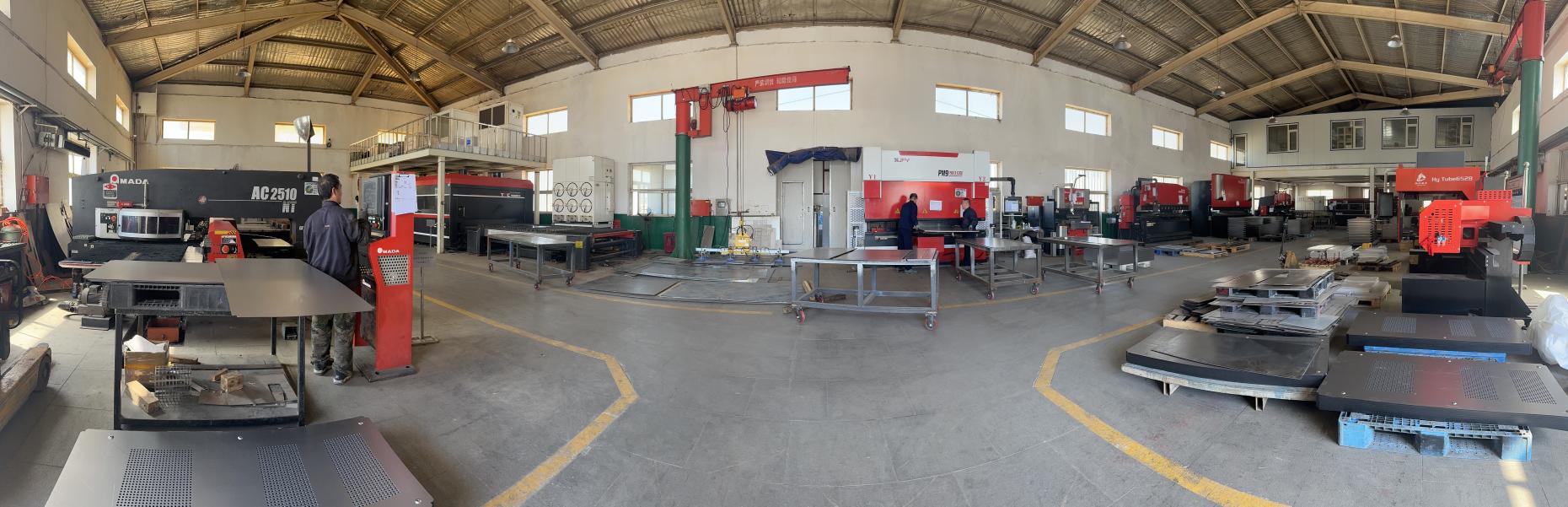
Dalian Yinlu Electrical Control Equipment Manufacturer (Yinlu) is a Dalian-based manufacturer working in sheet metal fabrication, enclosures, electrical control cabinets, intelligent control boxes and electrical distribution. The company operates a 5,000 m² facility with ISO 9001 certification, a six-person R&D team, and a monthly production capacity of 2,000 units, with around 80% of output exported to North American, European, Oceania and high-end Asia-Pacific markets. Non-standard customization is supported from drawings, parameters or functional requirements, and OEM and ODM orders are accepted.
Warranty boundaries
Warranty periods are stated at one or two years. Damage from human error, equipment burnt out by voltage instability, and unauthorized modification or disassembly fall outside cover, so incoming power quality and site discipline belong in the commissioning plan rather than in the warranty claim.
Purchasing terms and acceptance questions
Commercial terms follow the same pattern for both configurations, and they are worth confirming in writing before the drawing is released.
- Minimum order: 1 unit, so a first article or prototype can be ordered before a batch commitment.
- Delivery terms: FOB, CIF, EXW, DAP, CFR or DDP, agreed per order.
- Payment: 30% deposit with 70% balance before shipment for custom products, by TT, PayPal or LC; no credit sales, and documents are released against full payment.
- Acceptance window: 7 days after goods arrive, with any objection raised in writing; after that period the goods are deemed accepted.
- Testing before shipment: power-on functional test, insulation resistance test, withstand voltage test and grounding test, plus appearance, dimension and labeling inspection. Units that fail are not shipped.
- Packaging: wooden crates or reinforced packaging, moisture-proof film and anti-impact foam, with fragile, keep-dry and this-side-up marks on the outer carton; packaging is photographed before dispatch.
- Certification: genuine CE and RoHS documents for export orders, with no borrowed certificates and no altered files.
Five questions worth sending with the enquiry:
- Which standard and market does each certificate cover, and can it be matched to the unit shipped?
- Which component brands and model numbers are quoted, and are purchase invoices and certificates of conformity retained for the batch?
- Which tests will be recorded for this panel, and does the report travel with the shipment?
- What is the approved prototype, and how is mass production checked against it?
- Which parts of the warranty are excluded, and what evidence is required for a claim?
The full product range and customization scope are set out in the Yinlu product brochure (PDF), which can be downloaded and shared with the project team.
Frequently asked questions
What certification should a CE certified control panel come with for export?
Export orders should be supported by genuine CE and RoHS documentation that applies to the panel actually shipped, because borrowed certificates and altered files create clearance, fine and return risk. For North America, UL 508A is the benchmark for industrial control panels, while IEC 61439 is the international assembly standard (UL Solutions). Ask which standard and which market each document covers before the order is placed.
Can the same PLC and VFD equipment go into either enclosure?
Yes. Both the IP65 wall-mounted box and the stainless steel PLC cabinet are PLC and VFD compatible. The difference is packaging: the cabinet provides 19-inch mounting rails and double-door access for multi-drive panels, while the wall-mounted box has a smaller internal volume and a single front access face. Once drive count and heat load are known, the enclosure format follows.
Which option costs less over the life of the installation?
A purchase-price comparison cannot be settled without a line-item quotation, because material grade, finish, door count, rail system and component brands all move the number. The ownership side is easier to reason about: corrosion-resistant materials and an easy-access, modular internal layout reduce maintenance frequency and shorten downtime when a component is replaced. Request the cost breakdown and the maintenance-relevant features together.
Can we approve a prototype before mass production?
Yes. For custom and key-account orders the normal route is prototype first, client confirmation and sign-off, then mass production built strictly to the approved prototype standard. This applies to both enclosure formats, and it is why the signed drawing and the approved sample should be stored together as the reference for every later batch.
What capacity supports repeat orders and delivery planning?
Monthly production capacity is 2,000 units, which covers single custom builds as well as repeat batches for multi-line rollouts. Delivery terms are agreed per order — FOB, CIF, EXW, DAP, CFR or DDP — and the delivery schedule should be written into the contract rather than inferred from a catalogue, with acceptance completed within 7 days of arrival.
What does the warranty cover, and what should we check at acceptance?
Warranty is stated at one or two years and covers manufacturing faults; damage from human error, equipment burnt out by voltage instability, and unauthorized modification or disassembly are excluded. Acceptance should be completed within 7 days of arrival, with any objection raised in writing and supported by photos, video or a third-party inspection report. Shipment follows power-on, insulation resistance, withstand voltage, grounding and appearance checks. Buyers comparing the two enclosure formats for a specific project can send the single-line diagram and enclosure requirements to the Yinlu team at Sales@innometalfab.com, or start from the downloadable brochure linked above.
Conclusion: choose the enclosure your service plan can live with
The IP65 wall-mounted box and the stainless steel PLC cabinet are not competing for the same job. The box keeps local operation close to the machine in a 2.0 mm cold-rolled steel body that handles dust and water jets without taking floor space. The cabinet takes the larger PLC and VFD content, organises it on 19-inch rails behind double doors with EPDM sealing, and holds up in the wet and corrosive areas where a steel surface would not.
Decide on installation position, access frequency and corrosion exposure first; then lock material, doors, sealing and cable entry in a signed technical agreement, agree the component brand list and test plan, and confirm the purchasing and acceptance terms in the contract. That sequence is what keeps the first panel and the tenth one identical.
Have Questions or Need More Details?
Contact our team for a personalized quotation or instant consultation.
Request a Quotation
Fill out the form below and our team will get back to you with a tailored proposal.
WhatsApp Direct Chat
Prefer to chat in real-time? Message us on WhatsApp for instant assistance & quick answers.
- Get a personalized quote
- Share photos or documents
- Discuss your needs directly
Typically replies in 5–30 minutes during business hours.