
PLC Enclosure vs. Industrial Console vs. Wall-Mounted Box: A Buyer's Comparison
PLC Enclosure vs. Industrial Console vs. Wall-Mounted Box: A Buyer's Comparison
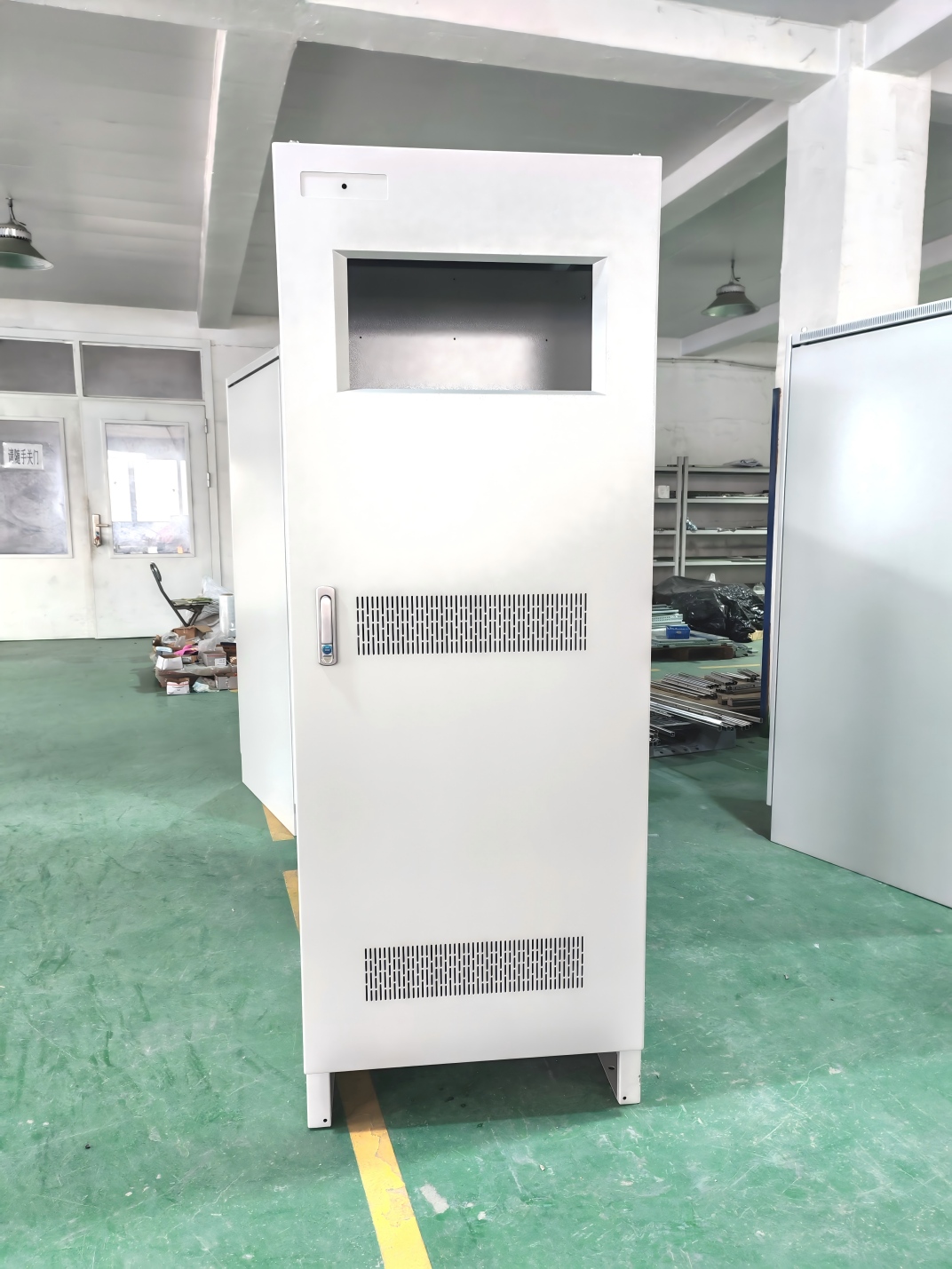
Most enclosure specification mistakes happen before anyone discusses material or colour. They happen when a project team picks a form factor — floor-standing cabinet, sloped console, or wall box — that cannot physically do the job the panel is supposed to do.
Short answer: a floor-standing PLC electrical enclosure is the right choice when the cabinet must house a 19-inch rack, an industrial PC, PLC modules, a switch, a power module, terminal blocks and DIN rails at floor level next to the machine. A sloped industrial console is the right choice when a human operator must read displays, meters and touch screens continuously — its 15°~30° sloped operation area exists for ergonomics, not for electrical capacity. A wall-mounted electrical control box is the right choice when the control or distribution function is small, the wall is the only available mounting surface, and the box can be either recessed flush or surface mounted.
Form factor decides three things that no later decision can repair: how much internal volume you get, which mounting interfaces (19-inch rack, mounting plate, DIN rail) exist inside, and where the operator interface sits relative to the person using it. Material, protection rating and finish are second-order decisions that should be made after the form factor is locked.
Problem Definition: Why the Wrong Form Factor Is Expensive
All three product families are passive protective structures. They have no active moving parts, they consume no energy, and they only provide physical protection for the devices inside them, operating synchronously with the internal equipment. When an operator console is described in the same breath as a floor-standing cabinet, buyers often assume the difference is cosmetic. It is not.
Three failure patterns repeat in industrial projects:
- Under-sized wall box: a specification calls for PLC control, a display, a power supply and a frequency converter, but the buyer orders a small wall-mounted distribution enclosure. The result is congested wiring, no room for a mounting plate layout that separates strong and weak current, and a thermal problem that appears only after commissioning.
- Over-specified console: a junction function that needs twelve terminals is placed in a spliced multi-screen console, consuming floor space, sheet metal and freight volume for no operational gain.
- Wrong operator geometry: a floor-standing cabinet is installed in a control room where operators sit for eight hours and need to read multiple screens. No amount of IP upgrading fixes a mounting position that ignores the operator.
The practical fix is a decision sequence that starts with the operator and the internal component list, then narrows to mounting method, internal interfaces, environment and cable entry — and only then to material and finish.
Industry Background: Where the Three Form Factors Sit in the Market
The global electrical enclosure market was valued at USD 14.02 billion in 2024 and is projected to reach USD 23.65 billion by 2032 (Market Research Future). Within that market, metallic enclosures — including stainless steel and carbon steel — accounted for 65% of global demand in 2025, valued at approximately USD 4.73 billion (Custom Market Insights). Asia Pacific held a 36% share of the market in 2025, driven by industrial automation and renewable energy investment in China and India (IMARC Group).
The form-factor mix matters as much as the total market size. The wall-mounted enclosure segment is expected to maintain market dominance through 2035 because of its compact design for small equipment installations (Precedence Research). That structural dominance is easy to misread: wall-mounted enclosures win on unit volume and installation convenience, not on internal capacity. Projects that need rack-mounted equipment, multi-screen operation or high-power distribution still move to floor-standing cabinets and consoles.
One specific sub-segment shows how application needs shape form factor and material together: the global stainless steel HMI enclosure market reached USD 1.47 billion in 2024, driven by hygiene requirements in food and pharmaceutical sectors (Dataintelo). Hygiene requirements push toward stainless steel and sealed construction rather than toward a different mounting method — which is exactly why material and form factor must be decided separately.
Protection performance is defined by one dominant international reference: IEC 60529 (IP Code), which rates enclosure protection against dust and water. Under IEC 60529, IP66 requires no ingress of dust and protection against powerful water jets. The IP Code defines the environmental envelope; the form factor defines the physical architecture. A buyer needs both, but in that order.
Competitively, the enclosure industry includes large international suppliers such as Rittal GmbH & Co. KG, Schneider Electric, ABB Ltd., Eaton Corporation and nVent HOFFMAN (Fortune Business Insights), alongside regional manufacturers that build to buyer drawings. Form factor selection does not depend on supplier size: the same three architectures are available across that supplier landscape.
Detailed Solution: The Three Form Factors in Detail
Option 1 — Floor-Standing PLC Electrical Enclosure
The floor-standing PLC electrical enclosure is built around the assumption that the heaviest, deepest and most rack-dependent equipment sits at floor level. Typical construction uses cold rolled steel at 2.0 mm thickness with phosphating rust removal and electrostatic powder coating in RAL7035, and the standard installation method is floor mounting with adjustable feet or casters at the bottom, so the cabinet can stand directly on a workshop floor.
The internal configuration is the defining feature. These cabinets are compatible with a 19-inch rack, an industrial PC, an HMI touch screen, a PLC, a network switch, a power module, terminal blocks, DIN rails and shelves or pallets. Some models add a top operation window for installing a display or keyboard — this is what separates a plain power cabinet from a genuine PLC enclosure. The single door carries a stainless steel handle lock and an EPDM sealing strip, and may include a transparent observation window in tempered glass or PC, or a ventilation louver for heat dissipation. Cable entry runs through knockout holes at the bottom or back with configurable waterproof cable glands.
Application fit is concentrated in factory automation production lines, intelligent equipment operation stations, shop floor data acquisition and monitoring (SCADA), and equipment remote operation and maintenance stations. The typical buyer question is not "how much space do I have on the wall" but "how do I get rack equipment, an industrial PC and power components into one serviceable footprint next to the machine."
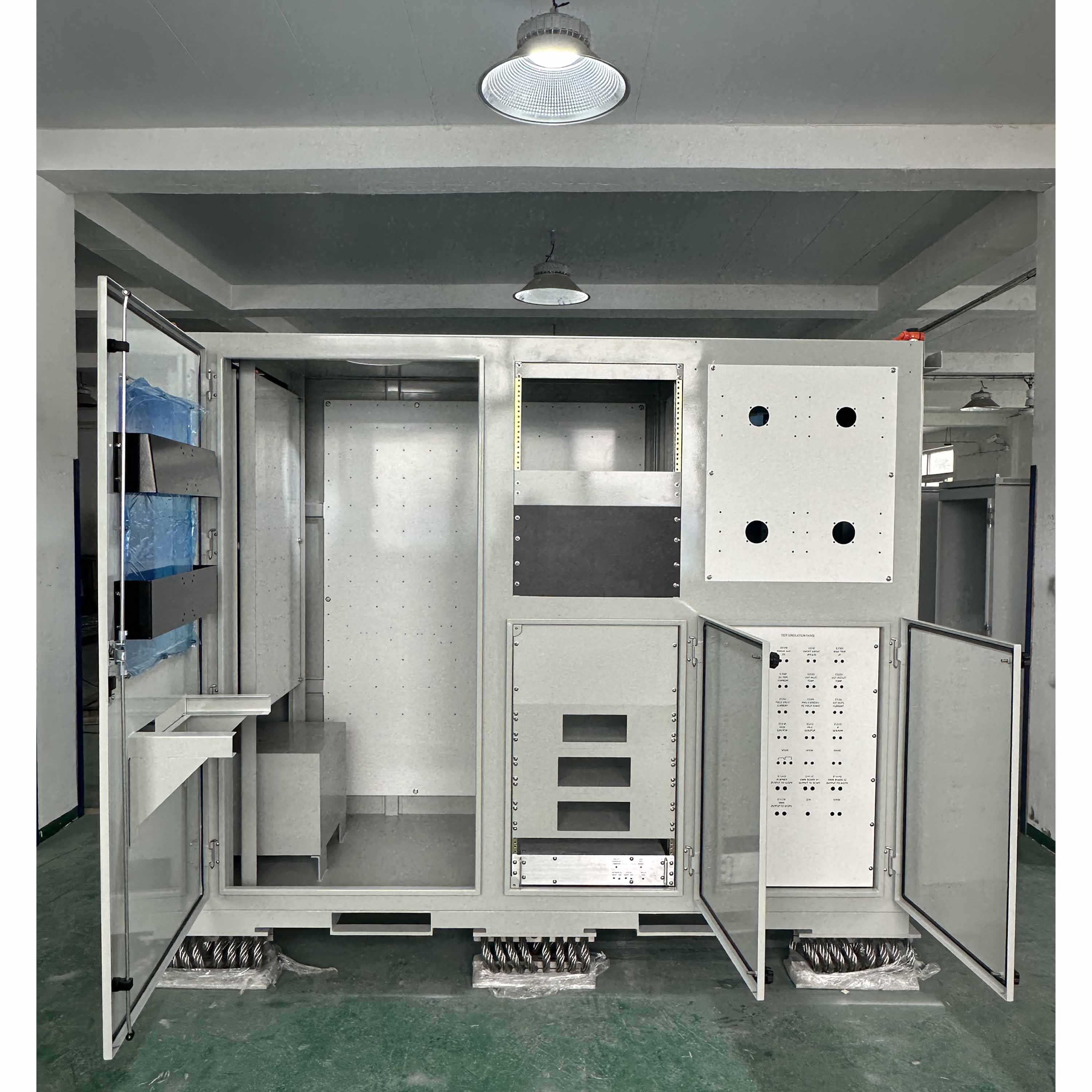
Within the same floor-standing family, buyers can choose variants that change capacity rather than architecture. A free standing modular enclosure (model YL0923-3) uses plate thickness of 2.0 mm or above, phosphating plus electrostatic powder coating in RAL7035, and protection rating IP54/IP55, with a multi-compartment layout: a front door with a transparent PC or tempered glass viewing window for HMI display, plus side and rear doors for installing electrical components and maintenance wiring, secured by a flush or handle lock. It can house an industrial PC, HMI touchscreen, PLC, network switch, power module, terminal blocks, DIN rails, and shelves or mounting plates.
Two further floor-standing variants extend the same architecture into harsher duties. A VFD control cabinet is built at 2.0 mm thickness with IP54/IP55 for indoor use and an optional IP65 for outdoor, waterproof and dustproof scenarios; it accepts DIN rails, mounting plates, 19-inch racks, PLC, VFD, circuit breakers, relays, terminal blocks, power modules and grounding bars, supports circuits up to 630A depending on internal components, has a customisable depth range of 500~800 mm, and offers good electromagnetic shielding performance against industrial site interference. A Rittal-style free-standing outdoor control cabinet is rated IP55/IP65 — completely dustproof and resistant to heavy rain jetting — and is designed for communication base stations, outdoor photovoltaic and energy storage, industrial automation, security and surveillance, water and environmental monitoring, and street lamp control.
Option 2 — Sloped / Desk-Style Industrial Console
The sloped industrial console exists because of human geometry. Its upper section is a sloped operation area at a 15°~30° angle, tuned for reading displays and operating controls; its lower section is an equipment compartment, drawer bank or door section for industrial PCs, power supplies and test instruments. Nothing in the electrical function requires the slope — the operator does.
Construction is comparable in materials but different in structure. A sloped industrial control console uses cold rolled steel at 2.0 mm thickness with phosphating derusting plus electrostatic powder coating in RAL7035, rated IP54 for dust and splash protection in workshop or test-room environments, floor-standing on adjustable feet for precise leveling, with some models on casters for mobility. The operating temperature range is 0℃ ~ +50℃, cabinet materials comply with the V-0 flame retardant standard, and reliable cabinet grounding with grounding resistance ≤4Ω is required. The lower section uses single or double doors or drawers with plane or handle locks, and built-in strong and weak current cable ducts keep wiring separated; heat dissipation holes or louvers sit on the side or bottom of the equipment compartment, with optional axial fans for internal cooling.
Panel functions are where the console earns its place: custom cutouts on the sloped panel accommodate instrument windows, button holes, indicator holes, display mounting holes and test interfaces. Optional accessories include drawers, doors, keyboard tray, mouse tray, display bracket, cable ducts, lighting, locks and PDU power sockets. Application fit centres on industrial automation, equipment manufacturing, electronic testing, power debugging, research laboratories and military testing.
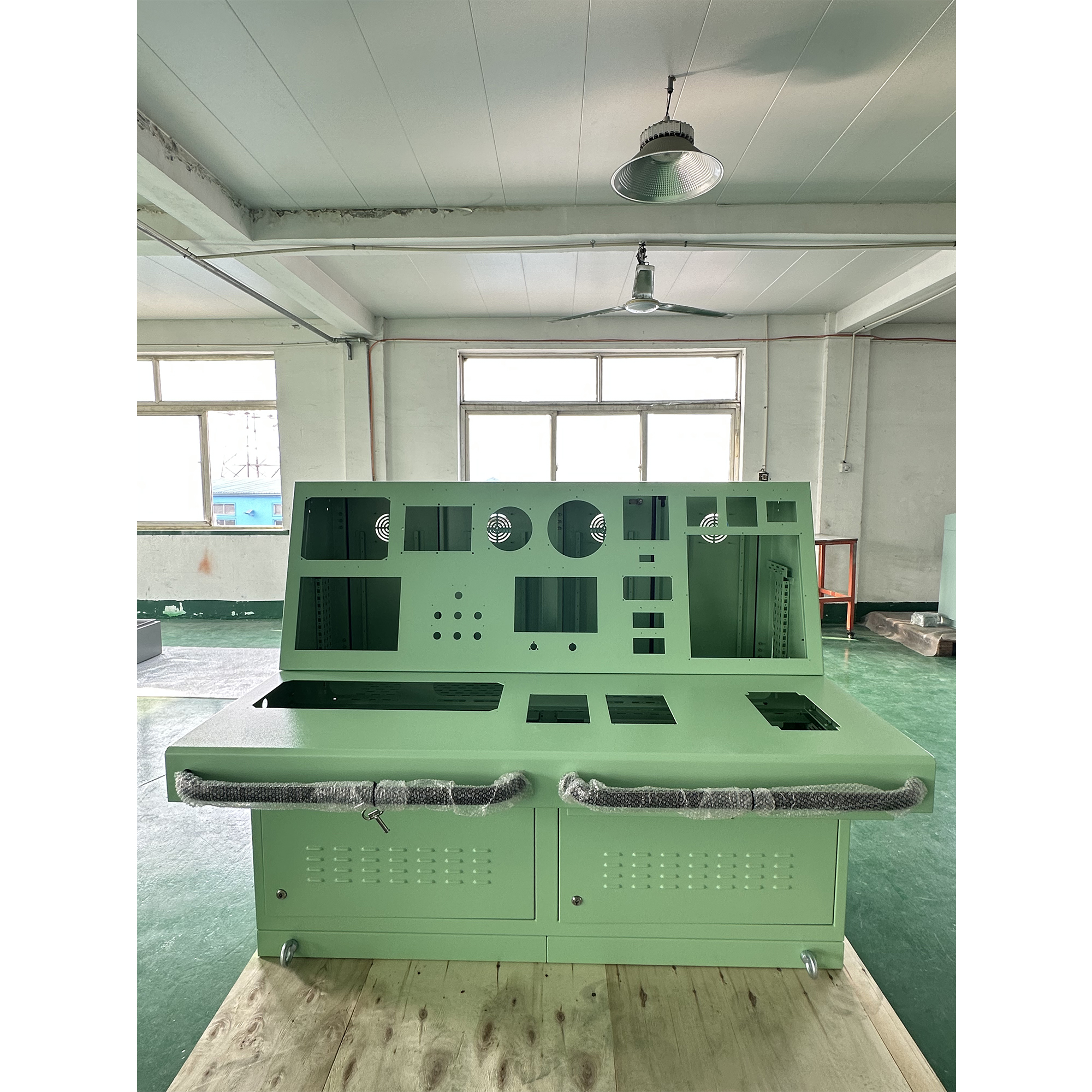
A PLC control console variant scales the same idea for command and dispatch environments. It is built from cold-rolled steel (SPCC) at 3.0 mm thickness with IP54 protection, floor-standing on adjustable feet, and it supports seamless curved or corner splicing to form circular or linear dispatch consoles — the mechanism that turns individual consoles into a continuous workstation row. It has a sloped upper operation area for multi-screen viewing, a lower multi-door equipment compartment with a removable back panel for maintenance, single, double or multi-door configurations with plane or handle locks, and side or lower louvered vents. Its operating envelope is 0℃ ~ +45℃, relative humidity ≤85% with no condensation, altitude ≤2000 m, vibration resistance compliant with GB/T 13384, and V-0 flame retardant materials. Typical deployment is smart city, traffic command, power dispatch, security monitoring, emergency command, rail transit and smart factory environments.
Option 3 — Wall-Mounted Electrical Control Box
The wall-mounted electrical control box is the smallest of the three and the most restricted in what it can carry. A standard customised wall-mounted electrical control box uses 1.5 mm cold rolled steel with phosphating treatment and electrostatic powder coating, rated IP54 with IP55 available, and it offers two installation methods — recessed flush mounting, pre-embedded in the wall, or surface wall mounting, depending on the on-site wall structure — with sturdy mounting holes provided at the bottom or back.
Internally it uses an integrated mounting plate, with separate installation areas reserved for terminals and components. DIN rails are usually not included but can be added according to component requirements, and an internal grounding copper bar is provided. The single door carries a dedicated flat lock, and the door frame is embedded with an EPDM rubber sealing strip. Cable entry uses multi-size knockout holes at the bottom, left or right to accept power or control cables of different diameters, with waterproof cable connectors available. Material options extend to 304 stainless steel.
Where this form factor performs best is rail transit and metro applications — station lighting power distribution, tunnel fan control, auxiliary control for platform screen door systems, and protection cabinets for communication and signal equipment — plus large factory equipment control cabinets, building weak current well junction boxes, and outdoor landscape lighting control cabinets.
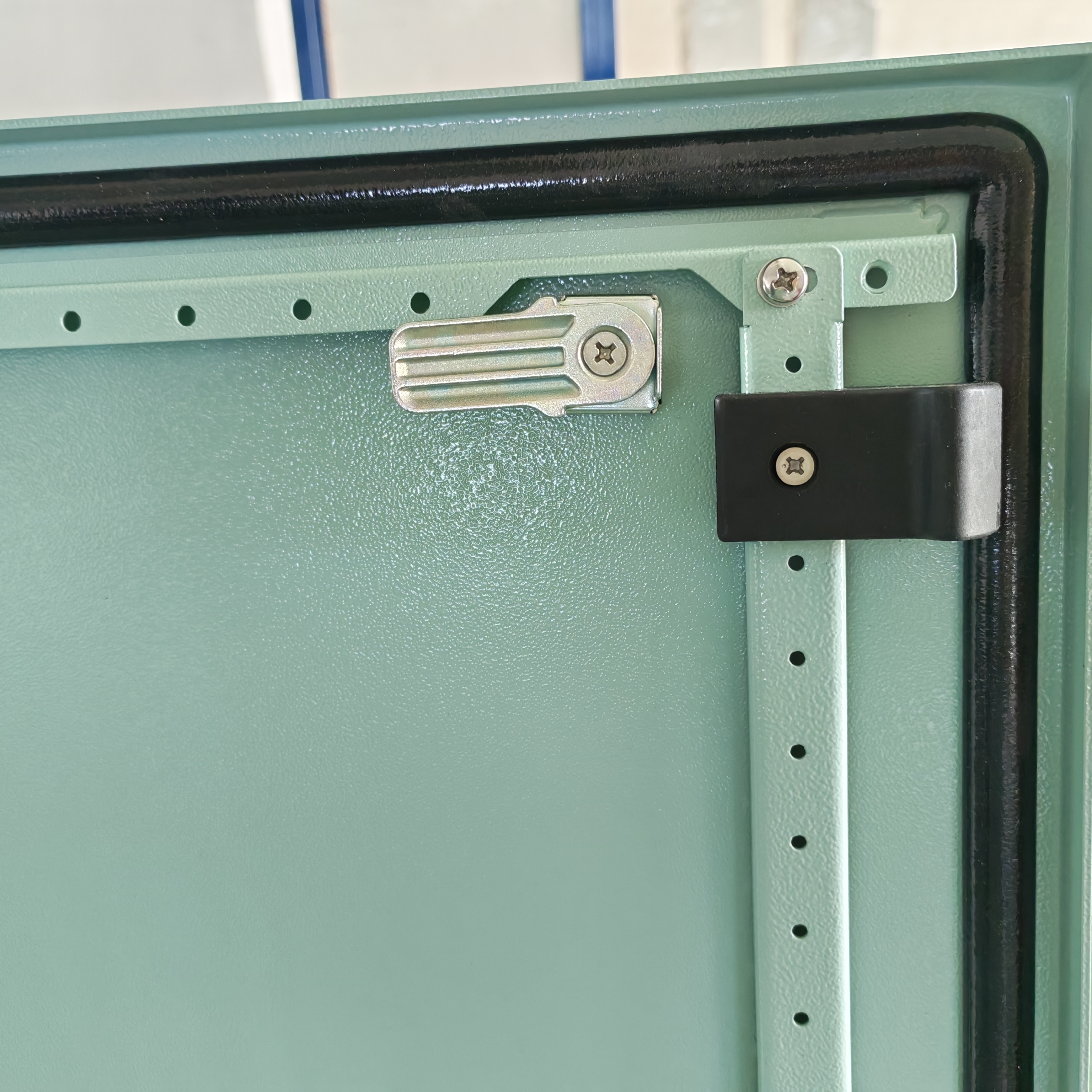
The wall-mounted family contains several specialised branches that solve specific constraints:
- HMI enclosure box: SPCC at 2.1 mm thickness, IP55, in RAL7035 or RAL7032, recessed or surface wall mounted, single door with a mechanical round or cam lock and bottom or side hinges, DIN rail at the bottom for terminals and circuit breakers, plus optional grounding terminal block. Knockouts on the side, bottom or rear accept waterproof cable glands or cord grips, and dimensions are customisable. It suits building weak current boxes, equipment local control boxes, field push button boxes, meter and instrument protection enclosures, and small distribution sub-boxes.
- Wall-mounted instrument box and multi-meter cupboard: 2.0 mm 304 stainless steel as standard with 316 stainless steel for corrosion or coastal duty, brushed finish, IP55, with four pre-drilled mounting holes on the back for fixing to a wall or to equipment with expansion screws or brackets. Single or double doors use a stainless steel plane lock or handle lock with keys, an EPDM rubber seal and a grounding jumper between door and cabinet. A built-in mounting plate or DIN rail with reserved instrument holes and a grounding bar supports pressure gauges, transmitters, digital meters, solenoid valves and small PLC modules.
- Outdoor weatherproof control enclosure: rated IP66 and wall-mounted, with brushed or polished stainless steel for enhanced corrosion resistance, single door, and space for DIN rails, mounting plates or shelves for terminals, instruments and circuit breakers. It is supplied with expansion screws, wall-mounting brackets, cable glands and grounding busbars, and is applied to outdoor PV combiner boxes, water conservancy and hydrological monitoring, communication base stations, oilfield and mining instrumentation, and street light control boxes.
What All Three Have in Common
Whatever the form factor, the enclosure is a passive protective structure with no active moving parts. It only provides physical protection for internal devices and operates synchronously with the internal equipment — 24-hour continuous or intermittent operation is determined by the industrial control equipment inside, not by the cabinet.
Core supporting equipment is consistent across the three types: pressure gauges, transmitters, digital meters, solenoid valves, terminal blocks, circuit breakers, sensors and small PLC modules. Auxiliary supporting equipment is equally consistent: cable glands, waterproof connectors, grounding bars, instrument brackets, heat dissipation louvers, dehumidifiers and observation windows. Buyers who plan the auxiliary list at specification stage avoid most commissioning surprises.
Step-by-Step Breakdown: How to Choose the Form Factor
The following sequence resolves the three-way choice in a predictable order. Each step produces one locked input for the next.
- Define the operator interaction. If a person reads displays, meters or touch screens as a primary task, the project needs a sloped console with a 15°~30° operation area or a control room console. If interaction is occasional — a reset button, a status lamp, a meter check — a flat door panel is sufficient.
- Count and classify the internal components. Rack-mount equipment, industrial PCs and frequency converters push the specification toward a floor-standing cabinet with 19-inch rail compatibility. Terminals, relays, MCBs and small PLC modules fit a mounting plate and DIN rail inside a wall box.
- Set the protection target against the actual site. Match the IP rating to the environment rather than to habit: IEC 60529 defines what each rating guarantees, and IP66 specifically means no dust ingress plus protection against powerful water jets.
- Confirm the mounting surface and access. Wall-mounted boxes need a suitable wall and either a pre-embedded recess or a clean surface for surface mounting. Floor-standing cabinets need floor area, service clearance in front of the door, and either adjustable feet for leveling or casters for mobility. Consoles need seating or standing space for the operator plus splicing space if multi-station operation is planned.
- Size the enclosure around the component layout, not the other way round. Provide the equipment drawings and cutout layout so sizes, depths and hole positions are matched to real components — all three families are customisable in size.
- Plan cable entry before ordering. Decide how many power and signal cables enter and from which direction. Knockouts at the bottom, back, left or right with waterproof cable glands are the standard approach across these products.
- Resolve heat and condensation. Louvers and optional axial fans cover ordinary internal heat loads; dehumidifiers and heaters are used where condensation risk exists. Inconsistency here is one of the most common causes of premature electronics failure.
- Lock material, finish and grounding. Cold rolled steel with electrostatic powder coating covers general industrial environments; 304 or 316 stainless steel covers corrosion and washdown duty. Confirm grounding: reliable cabinet grounding with grounding resistance ≤4Ω and a grounding jumper between door and cabinet are recurring requirements across the range.
- Validate with a sample before mass production. A physical sample confirms cutouts, mounting hole positions, door swing, louver placement and cable entry before tooling and batch production are committed.
Use Cases: Matching Form Factor to Real Projects
| Project scenario | Recommended form factor | Why it fits |
|---|---|---|
| Factory automation line with PLC, industrial PC and HMI screen at the machine | Floor-standing PLC electrical enclosure | Floor mounting with adjustable feet or casters; compatible with 19-inch rack, industrial PC, HMI touch screen, PLC, switch, power module, terminal blocks and DIN rail |
| Shop floor data acquisition and SCADA station with a viewing window | Free standing modular enclosure | Multi-compartment design with a transparent front viewing window for HMI screens and side/rear doors for wiring and maintenance |
| Production line with variable frequency drives | VFD control cabinet (floor-standing) | DIN rails, mounting plates, 19-inch racks, PLC and VFD ready; 500~800 mm custom depth; good electromagnetic shielding for industrial sites |
| Control room, dispatch centre or test laboratory with seated multi-screen operation | Sloped industrial console / control room console | 15°~30° ergonomic operation area; sloped cutouts for instrument windows, displays, buttons and test interfaces; keyboard and mouse tray options |
| Traffic command, power dispatch or emergency command centre | PLC control console | 3.0 mm SPCC build, seamless curved or corner splicing for circular or linear dispatch consoles, multi-display sloped area, GB/T 13384 vibration resistance |
| Metro station lighting distribution, tunnel fan control, platform screen door auxiliary control | Wall-mounted electrical control box | Recessed flush or surface mounting; 1.5 mm cold rolled steel; integrated mounting plate with separated terminal and component areas |
| Building weak current well, field push button box, small distribution sub-box | HMI enclosure box (wall-mounted) | IP55, DIN rail at the bottom, knockouts on side/bottom/rear with waterproof cable glands; customisable dimensions |
| Chemical, water treatment or food and pharma instrumentation point | Wall-mounted instrument box (304/316 stainless steel) | Brushed stainless steel, IP55, EPDM sealed doors, mounting plate or DIN rail with reserved instrument holes and grounding bar |
| Outdoor PV combiner box, street light control, hydrological monitoring | Outdoor weatherproof control enclosure (IP66) or floor-standing outdoor cabinet (IP55/IP65) | Wall-mounted IP66 stainless steel option for compact outdoor points; floor-standing IP55/IP65 cabinet where more internal space is required |
Comparison Table: Floor-Standing Enclosure vs. Console vs. Wall-Mounted Box
| Comparison criterion | Floor-standing PLC electrical enclosure | Sloped industrial console | Wall-mounted control box |
|---|---|---|---|
| Mounting method | Floor-mounted with adjustable feet or casters; can be placed directly on the workshop floor | Floor-standing with adjustable feet for precise leveling; some models with casters; supports curved or corner splicing | Recessed flush mounting, pre-embedded in the wall, or surface wall mounting; sturdy mounting holes at bottom or back |
| Typical material and thickness | Cold rolled steel at 2.0 mm; 304/316 stainless steel available on modular variants; phosphating plus electrostatic powder coating, RAL7035 | Cold rolled steel at 2.0 mm; SPCC at 3.0 mm on PLC control consoles; RAL7035 with optional two-tone finish | Cold rolled steel at 1.5 mm; SPCC at 2.1 mm on HMI boxes; 304 stainless steel standard on instrument boxes, 316 optional |
| Protection level (product options) | IP54 on the PLC enclosure; IP54/IP55 on the free standing modular enclosure; IP55/IP65 on outdoor floor-standing variants | IP54 (dustproof, splash-proof) for workshop, test room, control room and equipment room environments | IP54 with IP55 customisable on the control box; IP55 on the HMI box and instrument box; IP66 on the outdoor weatherproof enclosure |
| Internal mounting interfaces | 19-inch rack, industrial PC, HMI touch screen, PLC, switch, power module, terminal blocks, DIN rail, shelves or pallets | Sloped panel cutouts for instrument windows, buttons, indicators, displays and test interfaces; lower equipment compartment with doors or drawers | Integrated mounting plate with separate terminal and component areas; DIN rails usually not included but can be added |
| Operator interface | Unit door with optional transparent observation window (tempered glass or PC) or ventilation louver; some models with a top operation window for display and keyboard | Purpose-built 15°~30° sloped operation area; multi-screen viewing on control console variants | Flat door panel with lock; instrument and button cutouts available, but no integrated sloped desk |
| Cable entry | Knockout holes at bottom or back, configurable with waterproof cable glands | Built-in strong and weak current cable ducts; cable holes at bottom and back; routing space behind the sloped panel | Multi-size knockout holes at bottom, left or right; waterproof cable connectors available |
| Typical applications | Factory automation production lines, intelligent equipment operation stations, SCADA data acquisition, equipment remote operation and maintenance | Control rooms, dispatch centres, equipment monitoring rooms, industrial automation, equipment manufacturing, electronic testing, research laboratories | Rail transit and metro lighting distribution, tunnel fan control, platform screen door auxiliary control, building weak current wells, equipment local control boxes |
| Customisation scope | Size, structure, cutouts, IP rating, material, colour and surface treatment | Radian, size, splicing mode, sloped cutout layout, equipment compartment and accessory configuration | Size, depth, cutout layout, mounting method, protection rating and material including 304 stainless steel |
All values in this table are drawn from product specification data for these enclosure families. Protection ratings, thicknesses and temperature limits vary by model and configuration and should be confirmed against the final approved drawing.
FAQ
Protection ratings are defined by IEC 60529 (IP Code), the dominant international standard for rating enclosures against dust and water; under that standard IP66 requires no ingress of dust and protection against powerful water jets. In practice, the rating follows the environment rather than the form factor. A floor-standing PLC electrical enclosure is rated IP54, and a free standing modular enclosure is rated IP54/IP55. A sloped industrial console is rated IP54 for dust and splash protection in workshop, test room or control room conditions. A wall-mounted electrical control box is IP54 with IP55 available, the HMI enclosure box and wall-mounted instrument box are IP55, and the outdoor weatherproof control enclosure is IP66. Where a wall-mounted point faces direct rain, jet wash or salt spray, specify the IP66 outdoor enclosure or a 304/316 stainless steel body rather than upgrading a standard indoor box.
Yes — this is a normal requirement for mixed projects, and it is the reason buyers consolidate enclosure scope with a single OEM/ODM partner. Yinlu (Dalian Yinlu Electrical Control Equipment Manufacturer) is a metal enclosure customisation manufacturer based in Dalian, Liaoning Province, China, supplying sheet metal fabrication, enclosures, electrical control cabinets, intelligent control boxes and electrical distribution products, with an export share of about 80% across North America, Europe, Oceania and high-end Asia-Pacific markets. Its OEM/ODM customisation scope covers material, colour, logo, size, IP rating, surface treatment, and cutouts and mounting, with a monthly capacity of 2,000 units. That scope makes it possible to order a floor-standing PLC electrical enclosure, a sloped console and a wall-mounted control box to one drawing standard in a single contract.
Four factors dominate. First, sheet metal area and thickness: a wall-mounted box uses 1.5 mm to 2.1 mm material in a compact footprint, a floor-standing enclosure or console uses 2.0 mm and above across far larger surfaces, and a PLC control console can reach 3.0 mm. Second, material grade: cold rolled steel with electrostatic powder coating is the standard industrial specification, while 304 or 316 stainless steel raises cost in exchange for salt spray, acid and alkali resistance. Third, internal architecture: 19-inch rack compatibility, separate strong and weak current cable ducts, removable back panels and sloped cutout layouts add fabrication steps that a plain wall box does not require. Fourth, protection level, accessories and quantity — axial fans, dehumidifiers, heaters, observation windows, lighting and keyboard drawers all change the configuration, and larger volumes are quoted per project rather than from a fixed list. Floor-standing cabinets and consoles also occupy more freight volume than wall-mounted boxes, which affects delivered cost.
Yes, and it is the recommended approach. The minimum order quantity for these enclosure products is 1 to 5 units, which makes a physical sample practical for form-factor validation. A sample confirms what drawings cannot: whether the mounting plate layout actually accommodates the component set, whether the door swing clears the surrounding equipment, whether knockout positions match the real cable routing direction, and whether a sloped console angle suits the operator's seated or standing position. Every unit passes six quality control checks — visual, wiring, function, safety, sealing and packaging — so a sample also demonstrates the sealing and finish standard before a production batch is released.
Lead time is quoted per project because it depends on configuration, cutout complexity and order quantity; the manufacturer's monthly production capacity is 2,000 units, which is the reference point for planning larger mixed orders. Consolidating a floor-standing PLC enclosure, a console and wall-mounted boxes into one production and shipping schedule reduces the number of customs entries, packing specifications and delivery windows a project team has to manage, and the same partner covers after-sales with 7×24 online support and a one-year warranty. To move from specification to quotation, send the component list, cutout drawings and site environment details to Sales@innometalfab.com or WhatsApp +86 186-2435-1618, or download the product brochure below.
Conclusion
The three form factors are not competing versions of the same product. A floor-standing PLC electrical enclosure buys internal capacity and rack compatibility; a sloped industrial console buys operator ergonomics and multi-screen visibility; a wall-mounted box buys compactness and the ability to use vertical wall space where no floor is available. The correct order of decisions is form factor first, then internal interfaces, then environment and IP rating, then material and finish.
Two checks decide most projects correctly. First, ask who uses the panel and how often — continuous operator interaction points to a console, equipment-level control points to a floor-standing enclosure or a wall box. Second, bring the component drawing to the quotation stage so size, depth, cutouts and cable entry are matched to real equipment rather than to a catalogue default.
Yinlu has supplied customised enclosure solutions for industrial, energy, rail and process applications, including stainless steel non-standard enclosures for overseas industrial customers and enclosures built to the dimensional and interface requirements of internationally recognised instrument platforms, under an ISO 9001 quality system. Buyers who want to compare configurations across the three form factors can request a matched specification for all three from one source.
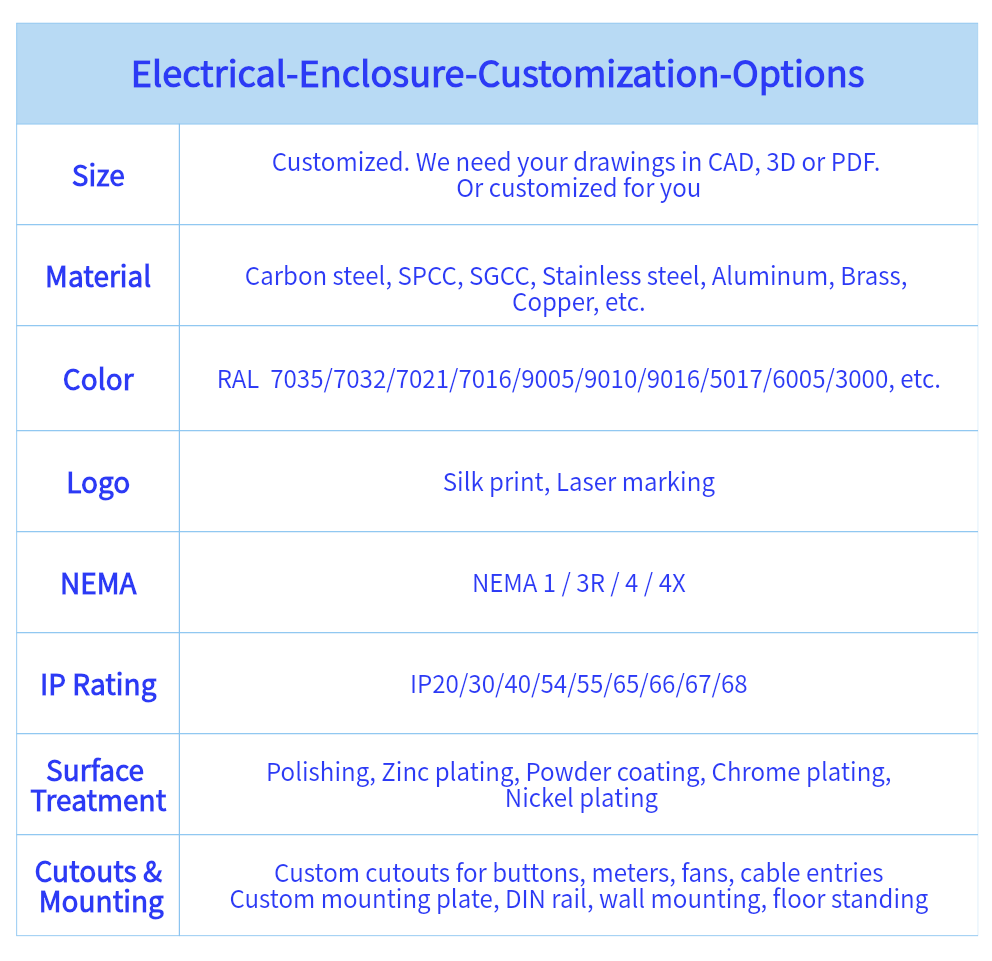
Next step: request a form-factor recommendation
Send your component list, cutout layout and site conditions, and receive a matched recommendation across floor-standing enclosures, sloped consoles and wall-mounted boxes — including material, IP rating and mounting options for each.
Email: Sales@innometalfab.com
WhatsApp / Tel: +86 186-2435-1618
Website: www.innometalfab.com
Product brochure (PDF): Download the Yinlu enclosure catalogue
Have Questions or Need More Details?
Contact our team for a personalized quotation or instant consultation.
Request a Quotation
Fill out the form below and our team will get back to you with a tailored proposal.
WhatsApp Direct Chat
Prefer to chat in real-time? Message us on WhatsApp for instant assistance & quick answers.
- Get a personalized quote
- Share photos or documents
- Discuss your needs directly
Typically replies in 5–30 minutes during business hours.