
Wall-Mounted Control Boxes vs. Floor-Standing Cabinets: A Practical Comparison
Wall-Mounted Control Boxes vs. Floor-Standing Cabinets: A Practical Comparison
Choosing between a wall-mounted control box and a floor-standing cabinet comes down to three variables rather than personal preference: where the enclosure can physically be mounted, how much dust and water the location exposes it to, and how much equipment and current it has to carry. Wall-mounted control boxes are compact, single-door enclosures built for machine-local control and instrument protection, commonly specified from IP54 to IP55 and upgradeable to IP65, with outdoor wall-mounted models reaching IP66. Floor-standing cabinets use a larger free-standing frame with single or double doors, 19-inch mounting rails and space for busbars and switching devices rated into the hundreds of amps.
This comparison sets the two formats side by side using verified specifications from custom wall-mounted control box models and from low-voltage switchgear and VFD cabinet lines, then closes with a five-step selection process, matching use cases, a side-by-side table and a buyer FAQ.
Problem Definition: Why the Wall-or-Floor Decision Goes Wrong
Most enclosure decisions fail at the specification stage, not at the factory. Three patterns repeat.
Mounting is treated as an afterthought. A wall-mounted box needs a wall, column or machine frame strong enough to carry it, with back mounting holes and enough clearance to open the door and pull cable. A floor-standing cabinet needs floor area, a level base and, for permanently installed switchgear, foot-bolt fixing — the low-voltage switchgear specification, for example, calls for foot-bolt fixing to a concrete floor built to C20 standard, with lifting eyes reserved on top for factory lifting and on-site handling.
Protection ratings are applied globally instead of locally. A workshop control box beside a packaging machine and an outdoor energy-storage cabinet do not face the same water and dust exposure, yet both are frequently written into the same specification line as IP65. Over-specifying the rating also has a cost inside the enclosure: a fully sealed cabinet traps heat, which is why thermal management hardware — louvers, filtered axial fans, heat exchangers or industrial air conditioners — appears as an option on both formats.
Capacity is judged by enclosure size instead of current. Two enclosures of similar footprint can sit at very different points on the electrical scale. A wall-mounted industrial socket box is configured around 16 A, 32 A or 63 A industrial sockets, while a low-voltage switchgear cabinet is configured at 630 A, 800 A or 1250 A. Sizing by appearance rather than by load, fault level and component count is the single most common cause of a late redesign.
Industry Background: Where the Two Formats Sit in the Market
Published market estimates for control and distribution equipment vary widely because different reports define “control panel” differently. Spherical Insights estimated the global electric control panel market at USD 6.35 billion in 2024, while Dataintelo projects the broader electrical control panels market to grow from USD 27.2 billion in 2025 to USD 47.0 billion by 2034. Global Market Insights values the distribution panel segment at USD 7.6 billion in 2024. Within the control panel category, low-tension panels held the largest share at 45.3% in 2025, and Asia Pacific accounted for 38.5% of global revenue in the same year (Dataintelo). Europe held the highest regional share in 2023, supported by established infrastructure and industrial automation demand, with Schneider Electric, ABB, Siemens, Eaton and Rittal named among the key global manufacturers (WiseGuyReports; Precedence Research).
Two technical reference points shape how buyers compare formats. First, IEC 61439-1:2020 is the primary international standard for low-voltage switchgear and controlgear assemblies, defining general definitions, construction requirements and verification methods — this is the standard normally referenced when assembly-level verification is discussed. Second, panels are increasingly networked: one market study estimates that approximately 70% of manufacturers now use IoT automation, which drives integration of PLCs with real-time data analytics (Maximize Market Research). In practice, that places more control content — PLCs, HMIs, communication modules and sensors — inside both wall-mounted local boxes and floor-standing cabinets, and it makes the layout decision more important than the enclosure shell alone.
Detailed Solution: The Five Differences That Actually Decide the Format
1. Installation space and mounting method
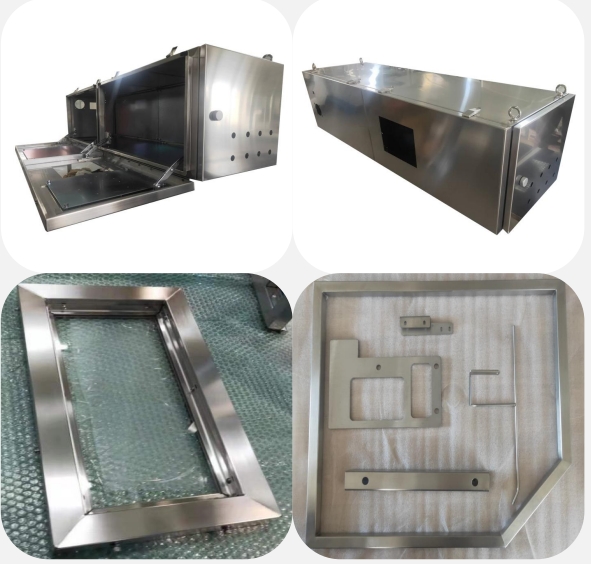
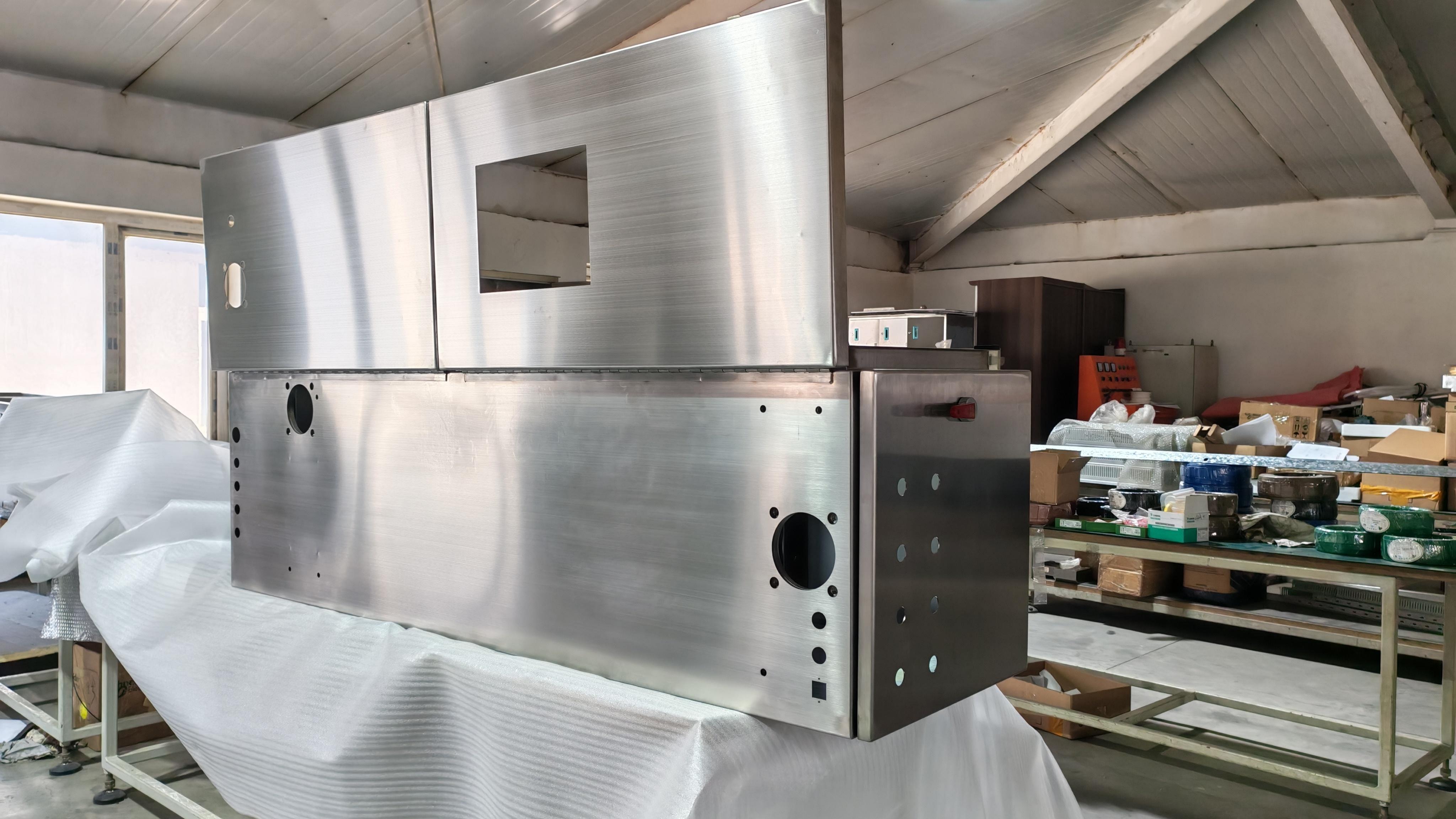
Wall-mounted enclosures are fixed to a wall, a column or the machine itself. One customized wall-mounted electrical control box is built for recessed flush mounting into a wall opening or for surface wall mounting, depending on the on-site wall structure, with sturdy mounting holes at the bottom or back. A small customized control box (local operation box) uses back mounting holes for wall or equipment-side mounting. A wall-mounted instrument box uses four pre-drilled holes on the back and is fixed to a wall or to equipment with expansion screws or brackets. Cable entry is handled by multi-size knockouts at the bottom, back or side, fitted with waterproof cable glands.
Floor-standing cabinets occupy floor space instead. They are placed directly on a workshop floor with adjustable feet or casters, or fixed permanently with foot bolts. The free-standing modular enclosure and the PLC enclosure both use adjustable leveling feet or casters; the low-voltage switchgear is fixed to a concrete base and lifted into position using the eyes reserved on top of the cabinet. That difference alone decides many projects: retrofitting a control point beside an existing machine usually means wall-mounted, while building a distribution room or a line-side power column means floor-standing.
2. Protection: what IP54, IP55, IP65 and IP66 mean in practice
Protection ratings describe resistance to dust and water, and both formats can be specified across more than one rating. In the product documentation reviewed for this comparison:
- IP54 is described as dustproof and splash-proof, and is used on indoor equipment such as the PLC electrical enclosure and the stainless steel electrical control cabinet, which is listed for indoor use at IP54/IP55.
- IP55 is described as dustproof and splash-proof and suitable for workshop sites. It appears on wall-mounted boxes — the small customized control box, the wall-mounted instrument box — and on floor-standing equipment such as the low-voltage switchgear and the port crane control cabinet.
- IP65 is described as dustproof and resistant to heavy rain jetting, suitable for outdoor exposed environments, and appears on floor-standing outdoor cabinets including the stainless steel double-door outdoor cabinet and the stainless steel double-door communication/energy-storage cabinet.
- IP66 appears on the wall-mounted outdoor weatherproof control enclosure.
The practical nuance is that IP65 is not automatically “better” than IP55 for every project. A wall-mounted box can be upgraded from IP55 to IP65 for outdoor scenarios, while a floor-standing VFD control cabinet can be ordered at IP54/IP55 for indoor duty or IP65 for outdoor and washdown conditions. The rating should be matched to the actual exposure — rain, hose-down, dust concentration, condensation — rather than applied as a blanket specification line.

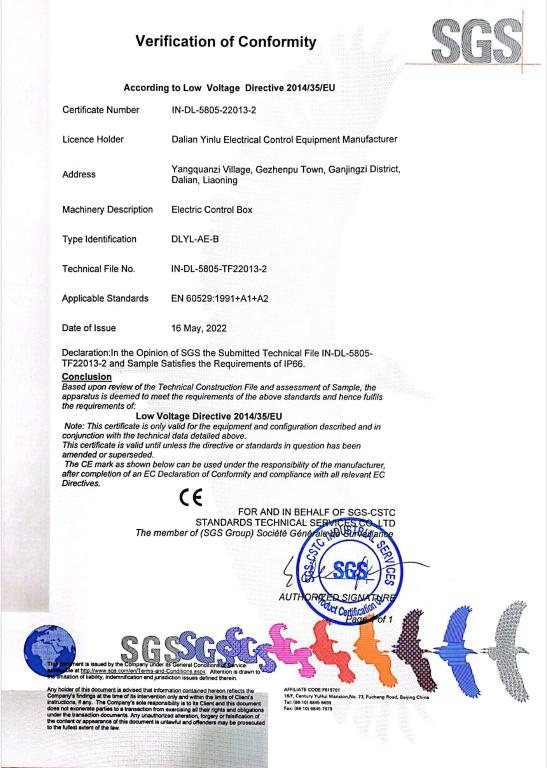
Compliance documentation follows the same logic. The manufacturer holds SGS-issued CE Verifications of Conformity to EN 60529:1991+A1+A2 under the EU Low Voltage Directive 2014/35/EU: certificate IN-DL-5805-22013-1 covers the DLYL-ES-C electric control cabinet with IP55 protection, and certificate IN-DL-5805-22013-2 covers the DLYL-AE-B electric control box. Both are model-specific, which is precisely the point: when a supplier claims a protection class, the certificate should name the exact model and rating being purchased.
3. Equipment capacity and current range
Wall-mounted control boxes are built around a mounting plate or DIN rail. The small customized electrical control box accommodates PLCs, relays, terminals, circuit breakers and drive modules on an internal mounting plate or DIN rail, with a grounding bar for electrical safety. The HMI enclosure box lists miniature circuit breakers, terminal blocks, relays, push buttons and indicator lights, small PLCs, meters and sensors among its matched components. Loads at this level are typically control and instrumentation, plus socket-level power where required: the wall-mounted industrial socket box is configured for 16 A, 32 A or 63 A industrial sockets to IEC 60309.
Floor-standing cabinets add depth, structure and current capacity. The VFD control cabinet has a customizable depth of 500–800 mm, accepts DIN rails, mounting plates, 19-inch racks, PLCs, VFDs, circuit breakers, relays, terminal blocks and power modules, and supports circuits up to 630 A. The low-voltage switchgear goes further: it is configured at 630 A, 800 A or 1250 A with a breaking capacity of 50 kA or 65 kA, uses a T2 copper busbar with tin plating for oxidation resistance, and complies with IEC 60439. Where very high currents are involved the format is effectively fixed — the port crane control cabinet (model YL251009-1) is rated for compatible circuit breakers up to 6300 A in a 316L stainless steel, IP55 body.
The working rule is that component count and current select the format, not enclosure size. A wall-mounted box with a 2.1 mm plate can carry a dense PLC control scheme; a floor-standing cabinet becomes necessary when the design includes busbars, main incoming switching, large drive modules or a high number of outgoing circuits.
4. Door structure: compact single doors versus double-door cabinets
Wall-mounted boxes are typically single-door. The small customized control box and the customized wall-mounted electrical control box both use a single door with a stainless steel flat lock, and the door frame carries an EPDM (ethylene propylene diene monomer) sealing strip. Instrument boxes in the range are available with single or double doors and use a plane lock or handle lock with keys, with a grounding jumper between door and cabinet.
Floor-standing cabinets use larger openings and heavier hardware. The low-voltage switchgear has double doors on heavy-duty hinges with MS lever locks and an EPDM rubber seal for high tightness. The stainless steel double-door outdoor cabinet and the double-door communication/energy-storage cabinet both specify double doors with stainless steel handle locks and reliable grounding bonding between the door and the cabinet body — a detail that matters when the door carries instruments, or when electrical continuity must be maintained while the door is open.
Three questions decide door configuration: how much internal width must be accessible at once, how much door-swing clearance the room allows, and whether the door itself will support devices. Where a single panel would be too wide or too heavy to handle, a double-door front is the standard solution.
5. Materials, sealing and thermal management
Both formats are built from sheet steel by default. Wall-mounted boxes in the range use cold-rolled steel plates of 1.5 mm (customized wall-mounted electrical control box) and 2.1 mm (small customized control box, HMI enclosure box), with 304 stainless steel available on wall-mounted and instrument box models. Floor-standing cabinets use 2.0 mm plate on the free-standing outdoor cabinet, the PLC enclosure and the VFD cabinet, and 2.5 mm on the low-voltage switchgear, with 304 or 316 stainless steel options for corrosive environments.
Surface treatment is consistent across the two families: phosphating for rust removal followed by electrostatic powder coating on cold-rolled steel, and a brushed finish on stainless steel versions. EPDM sealing strips are used on both wall-mounted and floor-standing doors.
Thermal management is where the two formats diverge most in day-to-day operation. A small wall-mounted box often dissipates heat passively through the enclosure surface, with ventilation louvers and optional axial fans available. Floor-standing cabinets offer more options because they have more internal volume and more surface area: the low-voltage switchgear uses back and side heat-dissipation louvers with optional industrial axial fans and filter mesh to prevent dust ingress, while the VFD cabinet offers axial fans with filters, heat exchangers or an industrial air conditioner. For outdoor duty in cold regions, insulation can be added — one outdoor cabinet design uses polyurethane foam insulation of 50–100 mm thickness with a thermal conductivity of ≤0.024 W/(m·K), rated for ambient temperatures from −40 °C to +60 °C.
Step-by-Step Breakdown: A Five-Step Selection Process
Step 1 — Define the electrical duty first. Record the connected load, the rating of the main incoming device and of the largest outgoing device, and whether busbars are required. If the answer includes 630 A-class circuits, 50 kA breaking capacity or a copper busbar, the format is floor-standing. If the answer is PLC I/O, relays, terminals, small breakers and instrumentation, a wall-mounted box will usually carry it.
Step 2 — Check mounting and access. Confirm where the enclosure can be fixed: wall, machine frame or floor. Wall-mounted boxes require a suitable wall or frame plus back mounting holes and knockouts at the bottom, back or side; floor-standing units require level floor area and, for permanently installed switchgear, foot-bolt fixing to a concrete base. Verify door swing, cable gland access and the lifting route to the installation point.
Step 3 — Set protection and corrosion level from the environment. Select the IP rating from real exposure — indoor workshop conditions, splash zones, outdoor rain, washdown areas — and confirm that the supplier's certificate covers that rating. Then set the material: cold-rolled steel with powder coating for ordinary indoor duty, 304 stainless steel for atmospheric and fresh-water exposure, and 316 stainless steel where salt spray or chemical exposure is present.
Step 4 — Lay out the interior before choosing a size. Decide whether the internal architecture is a mounting plate and DIN rail or 19-inch rails and uprights; whether compartments are needed to separate power, control and maintenance areas; how cable entry and separate strong/weak current routing will be handled; and how much working space maintenance staff need inside the door.
Step 5 — Close the thermal and documentation loop. Size ventilation against the internal heat load using louvers, filtered fans, heat exchangers or an industrial air conditioner. Then confirm the paperwork: model-specific CE documentation to EN 60529, assembly-standard compliance, and the inspection regime. Quality control for custom builds covers visual, wiring, function, safety, sealing and packaging checks before shipment.
Use Cases: Matching Format to Function
Machine-local control and instrument protection. Industrial automation equipment, packaging machinery, food machinery, water treatment equipment, testing equipment and special purpose machine tools are typical wall-mounted applications, where a compact box sits beside the machine it controls. Building weak current boxes, equipment local control boxes, field push button boxes and meter or instrument protection enclosures follow the same logic.
Rail transit and building services. Wall-mounted electrical control boxes are applied to metro station lighting power distribution, tunnel fan control, auxiliary control for platform screen door systems, and protection cabinets for communication and signal equipment, as well as building weak current well junction boxes and outdoor landscape lighting control cabinets.
Factory automation and drive control. Where variable frequency drives and larger component sets are involved, the format shifts to floor-standing: the VFD control cabinet is designed for factory automation production lines, intelligent equipment, water treatment, environmental protection equipment and material handling, with a customizable depth of 500–800 mm and heat dissipation options. The PLC enclosure covers SCADA stations and equipment remote operation and maintenance stations.
High-power distribution. The low-voltage switchgear is configured for AC 400 V, 415 V or 440 V three-phase five-wire systems at 50 Hz, and is used for high-power distribution and protection in hotels, schools, factories and large supermarkets.
Outdoor, energy and telecom duty. Double-door 316 stainless steel cabinets rated IP65 with 19-inch mounting rails serve communication base stations, energy storage power stations, outdoor photovoltaic systems, chemical industry parks, coastal ports, offshore platforms and sewage treatment plants.
Heavy industry environments. Port handling machinery, coke oven machinery and stacker-reclaimers use enclosures that protect PLCs, frequency converters and sensors from dust, high temperature and corrosion, with protection classes up to IP55/IP65/IP67 available on request — almost always in floor-standing format.
Non-standard stainless steel projects. As a reference point for the custom end of the range, Yinlu supplied 1,000 stainless steel non-standard enclosures to PACRAFT in Japan, where the core purpose was to protect customized electrical equipment, instruments and control modules while acting as a structural carrier for component integration and wiring.
Comparison Table: Wall-Mounted Control Box vs. Floor-Standing Cabinet
| Decision factor | Wall-mounted control box | Floor-standing cabinet |
|---|---|---|
| Typical mounting | Back mounting holes for wall or equipment-side mounting; recessed flush mounting into a wall opening or surface wall mounting | Free-standing on the floor with adjustable feet or casters; foot-bolt fixing to a C20 concrete floor for permanently installed switchgear |
| Plate thickness and material | Cold-rolled steel at 1.5 mm and 2.1 mm; 304 stainless steel versions available | Cold-rolled steel at 2.0 mm and 2.5 mm; 304 and 316 stainless steel versions available |
| Protection ratings in the range | IP54/IP55 standard on indoor models; IP55 upgradeable to IP65; IP66 on the outdoor wall-mounted enclosure; IP44/IP55/IP67 options on the industrial socket box | IP54/IP55 indoor through IP65 outdoor; IP67 available on selected heavy-industry enclosures |
| Door structure | Single door with stainless steel flat lock; instrument boxes available in single or double door with plane or handle lock | Single or double doors with stainless steel handle locks; heavy-duty hinges and MS lever locks on switchgear; grounding bonding between door and cabinet body |
| Internal layout | Mounting plate or DIN rail; PLCs, relays, terminals, circuit breakers, drive modules; matched components include MCBs, push buttons, small PLCs, meters and sensors | 19-inch rails or uprights; industrial PC, HMI, PLC, VFD, breakers, relays, power modules and busbars; compartment layouts for power, control and maintenance |
| Current scope | Control and instrument loads; socket-level power at 16 A, 32 A or 63 A on the wall-mounted industrial socket box | Circuits up to 630 A in the VFD cabinet; switchgear configured at 630 A, 800 A or 1250 A with 50 kA or 65 kA breaking capacity |
| Typical applications | Machine-local control, packaging and food machinery, water treatment equipment, testing equipment, building weak current boxes, instrument protection | VFD and automation lines, high-power distribution in hotels, schools, factories and large supermarkets, outdoor energy storage, telecom and PV sites |
| Choose this format when | No floor footprint is available, the enclosure must sit beside the machine, and the load is control-level | Component count, busbar distribution, high incoming current, front-access maintenance or outdoor duty dominates the requirement |
FAQ: Wall-Mounted Boxes vs. Floor-Standing Cabinets
Do wall-mounted control boxes and floor-standing cabinets need different certifications?
No. Certification is tied to the specific model, its protection class and its intended market, not to whether the enclosure is mounted on a wall or on the floor. Dalian Yinlu holds two SGS-issued CE Verifications of Conformity to EN 60529:1991+A1+A2 under the EU Low Voltage Directive 2014/35/EU: certificate IN-DL-5805-22013-1 covers the DLYL-ES-C electric control cabinet with IP55 protection, and certificate IN-DL-5805-22013-2 covers the DLYL-AE-B electric control box. At assembly level, IEC 61439-1:2020 is the primary international standard for low-voltage switchgear and controlgear assemblies, and the low-voltage switchgear specification references IEC 60439. The buyer's check is straightforward: the certificate must name the exact model and protection rating being ordered.
How much equipment and current can each format handle?
Wall-mounted boxes carry control-level content on an internal mounting plate or DIN rail — PLCs, relays, terminal blocks, circuit breakers, drive modules, meters and sensors — and are used for machine-local control and instrumentation; where socket-level power is needed, the wall-mounted industrial socket box is configured for 16 A, 32 A or 63 A industrial sockets. Floor-standing cabinets add 19-inch rails or uprights and can carry industrial PCs, HMIs, PLCs, VFDs, power modules and copper busbars. Within this range, the VFD control cabinet supports circuits up to 630 A with a customizable depth of 500–800 mm, and the low-voltage switchgear is configured at 630 A, 800 A or 1250 A with a 50 kA or 65 kA breaking capacity. The dividing line is normally busbars, main incoming switching and large drive content — once those appear, the format is floor-standing.
What drives the cost difference between a wall-mounted box and a floor-standing cabinet?
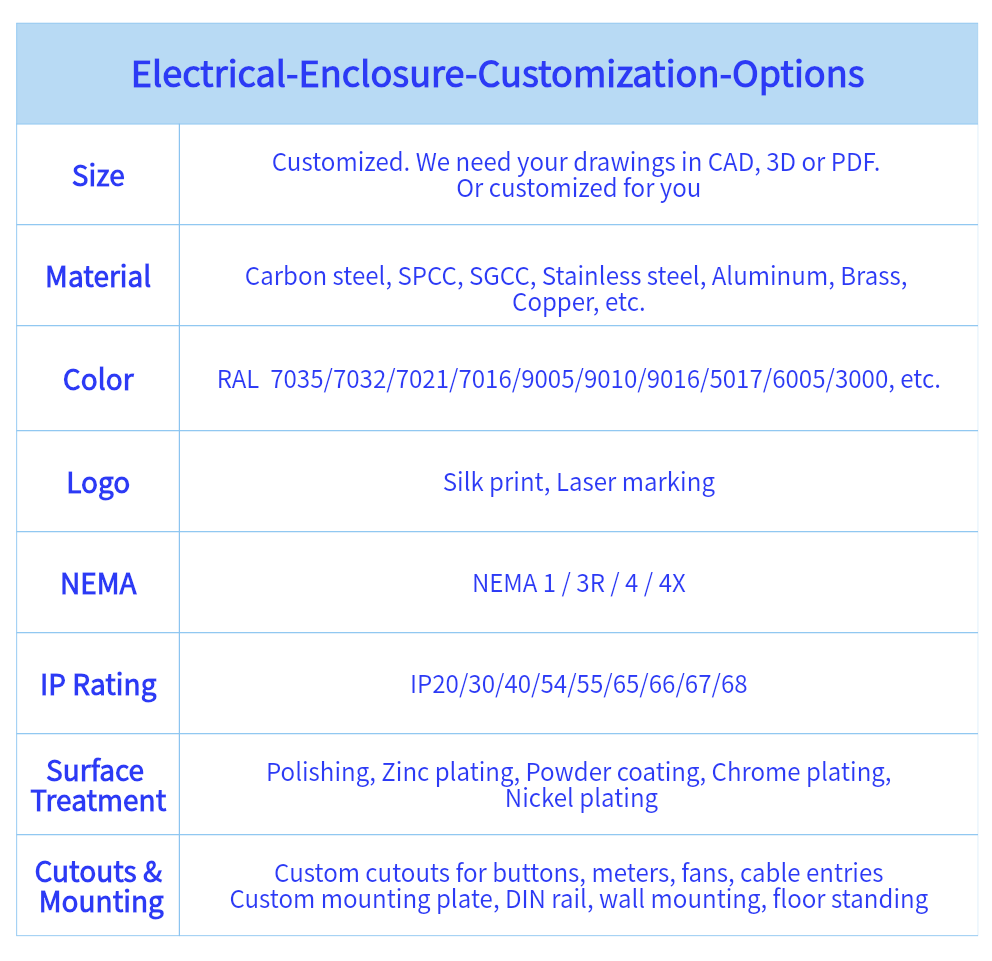
Enclosures of this type are quoted per project rather than from a list price, because each unit is built around the buyer's component layout. The main cost drivers are material grade (cold-rolled steel compared with 304 or 316 stainless steel), plate thickness (1.5 mm to 2.5 mm across the two families), the protection rating and sealing design, door structure (a single flat-lock door compared with double doors on heavy-duty hinges with lever locks), the busbar and switching content inside the cabinet, thermal management hardware (louvers, filtered axial fans, heat exchangers or an industrial air conditioner), and the documentation required for the destination market. Customization covers material, color, logo, size, IP rating, surface treatment, cutouts and mounting.
Can we validate both formats before placing a full order?
Yes. Minimum order quantities start at 1–5 units for custom builds, which allows a wall-mounted box and a floor-standing cabinet to be produced to the same project specification for side-by-side evaluation. Monthly production capacity is 2,000 units, and quality control covers visual, wiring, function, safety, sealing and packaging checks. Most buyers use the first sample to verify cutout positions, cable entry, door swing and sealing performance before releasing a larger batch.
What lead time and after-sales support should buyers expect?
Lead time is negotiated per project because it depends on customization scope, material availability and component lead times; production runs against a monthly capacity of 2,000 units, and the schedule is confirmed at order. After-sales support is provided 7×24 hours online with a one-year warranty, and around 80% of output is exported to North America, Europe, Oceania and high-end Asia-Pacific markets. To start, request a sample or a project quote, or download the product catalogue, and the engineering team will review your component layout, mounting conditions and protection requirements.
Conclusion: Let the Installation Decide, Not the Catalogue
The comparison reduces to a simple rule. If the control point sits beside a machine, the load is control-level and a wall or frame is available, a wall-mounted control box is the efficient choice — compact, single-door, IP54 to IP65, with EPDM sealing and back mounting holes for wall or equipment-side installation. If the requirement includes busbars, incoming switching, drive modules, a high outgoing circuit count or outdoor duty, a floor-standing cabinet is the correct format, with double doors on heavy-duty hinges, 19-inch rails, 630 A to 1250 A configurations and louver or active cooling options.
Both formats are built to order in cold-rolled steel or 304/316 stainless steel, and both are covered by model-specific CE documentation to EN 60529. The decision should be documented early in the project, together with the IP rating, the material grade and the required certificate scope, so that fabrication starts from a settled specification rather than from a catalogue picture.
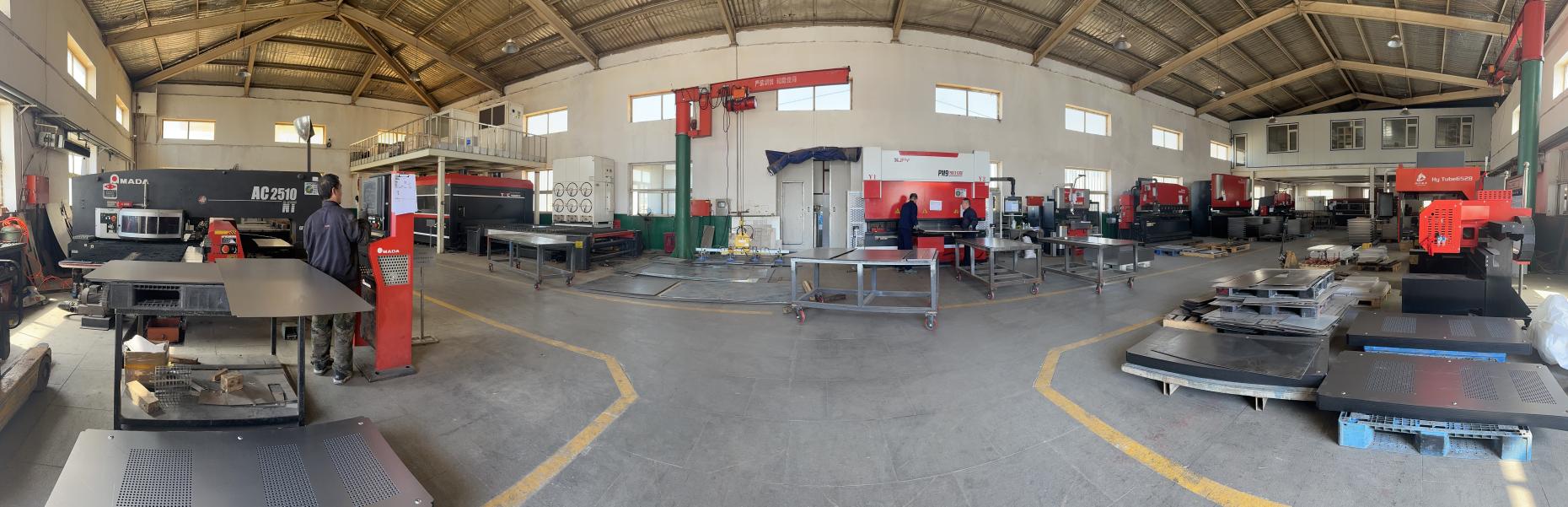
About the manufacturer. Dalian Yinlu Electrical Control Equipment Manufacturer is a sheet metal fabrication and enclosure company based in Ganjingzi District, Dalian, Liaoning Province, China, operating a 5,000 m² facility with an annual output of approximately 20,000 units. The company produces custom metal enclosures, electrical control cabinets, intelligent control boxes and electrical distribution equipment, supports OEM/ODM orders, and serves customers in North America, Europe, Oceania and high-end Asia-Pacific markets. Website: www.innometalfab.com; email: Sales@innometalfab.com.
Next step: compare the two formats on your own drawing
Send your component layout, mounting conditions and required IP rating, and the engineering team will confirm whether a wall-mounted box or a floor-standing cabinet is the better fit, then quote a sample or production quantity (MOQ 1–5 units). You can also download the full product catalogue for specifications across both formats.
Download the product catalogue (PDF) | Email: Sales@innometalfab.com | Tel / WhatsApp: +86 186-2435-1618 | Chat on WhatsApp
Have Questions or Need More Details?
Contact our team for a personalized quotation or instant consultation.
Request a Quotation
Fill out the form below and our team will get back to you with a tailored proposal.
WhatsApp Direct Chat
Prefer to chat in real-time? Message us on WhatsApp for instant assistance & quick answers.
- Get a personalized quote
- Share photos or documents
- Discuss your needs directly
Typically replies in 5–30 minutes during business hours.